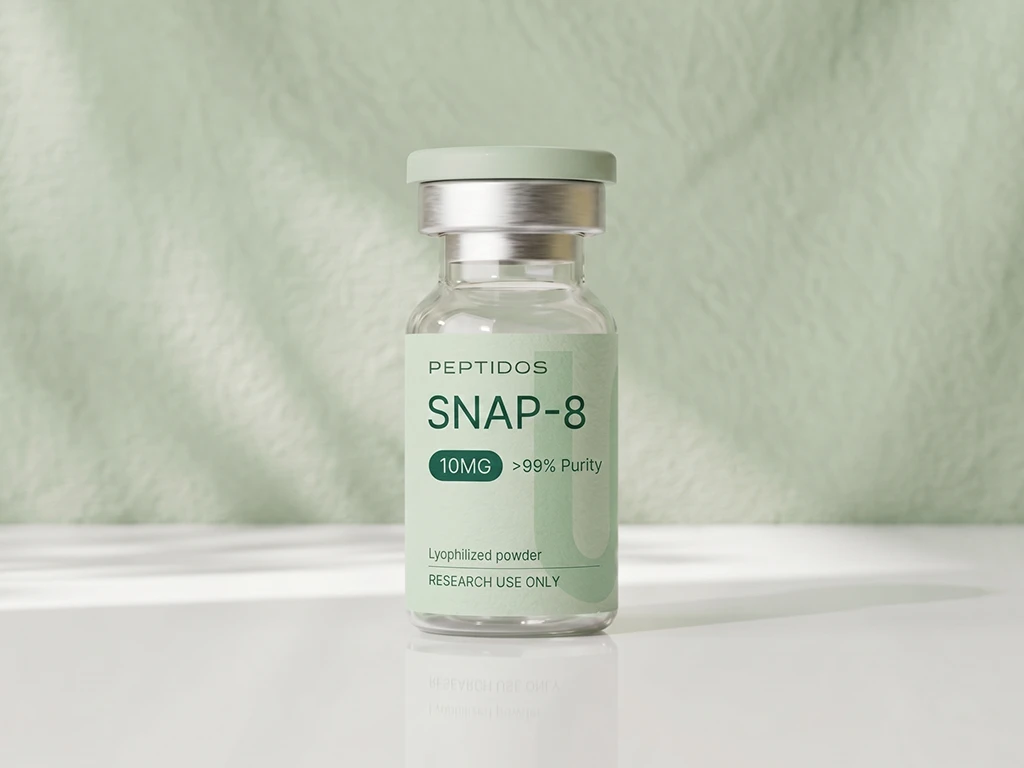
SNAP-8
Synthetic octapeptide modeled on the N-terminal fragment of the SNAP-25 protein, extensively studied for its role in easing muscle tension beneath the skin and softening visible expression lines.
What Is SNAP-8?
SNAP-8 (Acetyl Octapeptide-3) is a synthetic peptide composed of 8 amino acids, designed as an extended analog of Acetyl Hexapeptide-3 (Argireline) with two additional residues — alanine and aspartate — added to improve binding affinity and stability. Originally developed by Lipotec, it has attracted significant scientific interest as a topical cosmeceutical research compound for its ability to modulate the SNARE complex, the molecular machinery responsible for neurotransmitter release at the neuromuscular junction.
Its underlying biological role mimics the N-terminal end of the endogenous SNAP-25 protein. Studies indicate that SNAP-8 competitively interferes with SNARE complex assembly, reducing acetylcholine release and the muscle contractions that drive the formation of dynamic facial wrinkles (Blanes-Mira et al., 2002).
Mechanism of Action
SNAP-8 is studied for its ability to act as a competitive antagonist of SNAP-25 within the SNARE complex. By mimicking the N-terminal domain of SNAP-25, it disrupts vesicle fusion at the synaptic membrane, attenuating calcium-dependent catecholamine and acetylcholine release (Blanes-Mira et al., 2002; Raikou et al., 2017). This biochemical, non-toxic mechanism differs fundamentally from botulinum toxin, which enzymatically cleaves SNAP-25 — SNAP-8 simply competes for the binding site.
Key Areas of Research
Expression Line & Wrinkle Reduction
In vitro and topical research models report SNAP-8 to be approximately 30% more active than its parent hexapeptide Argireline, with clinical evaluations showing reductions in wrinkle depth of up to 63% after 28 days of twice-daily application (Jung et al., 2020).
SNARE Complex & Vesicle Fusion Studies
SNAP-8 is widely used as a reference compound in biochemical assays investigating SNAP-25 competition, vesicle-fusion signaling, and neuromuscular junction modulation in cell-free models (Blanes-Mira et al., 2002).
Dermal Delivery & Formulation Research
Because of its large, hydrophilic structure, SNAP-8 is a frequent subject of percutaneous delivery research, including studies on dissolving microneedle (DMN) patches and enhanced topical vehicles designed to improve stratum corneum permeation.
Synergistic Peptide Studies
Research has explored combinations of SNAP-8 with complementary peptides such as Acetyl Hexapeptide-3 and Pentapeptide-18, with formulations showing additive rejuvenation effects in skin models (Raikou et al., 2017).
Research Use Only
SNAP-8 supplied by Peptidos.eu is intended exclusively for laboratory and scientific research. It is not approved for human or animal consumption and must not be used as a medicine, cosmetic, or diagnostic tool.
- Chemical name
- Acetyl Octapeptide-3 (SNAP-8)
- Purity
- 99.747%
- Molecular formula
- C₄₁H₆₈N₁₆O₁₄S
- Amino acid sequence
- Ac-Glu-Glu-Met-Gln-Arg-Arg-Ala-Asp-NH₂
- CAS number
- 868844-74-0
- Molecular weight
- 1075.16 g/mol
- Number of amino acids
- 8
- Appearance
- White to off-white lyophilized powder.
- Solubility / reconstitution
- Highly water-soluble. Reconstitute in bacteriostatic or deionized water; dissolves readily to a clear solution.
- Storage
- Stable for 36 months (lyophilized, 2–8°C). After reconstitution store at 4°C and use within ~2 weeks.
- Blanes-Mira, C., et al. (2002). A synthetic hexapeptide (Argireline) with antiwrinkle activity. International Journal of Cosmetic Science, 24(5), 303–310.
- Jung, J. H., et al. (2020). Method development for acetyl octapeptide-3 analysis by liquid chromatography-tandem mass spectrometry. Journal of Analytical Science and Technology, 11(1), 35.
- Raikou, V., et al. (2017). The efficacy study of the combination of tripeptide-10-citrulline and acetyl hexapeptide-3. A prospective, randomized controlled study. Journal of Cosmetic Dermatology, 16(2), 271–278.
- Resende, D. I. S. P., et al. (2021). Trendy bioactive peptides in cosmetic formulations. Cosmetics, 8(2), 21.
- Errante, F., et al. (2020). Cosmeceutical peptides in the framework of sustainable wellness economy. Frontiers in Chemistry, 8, 572923.
- Wang, Y., et al. (2013). The anti-wrinkle efficacy of acetyl hexapeptide-3 and acetyl octapeptide-3 transdermal gel. Aesthetic Plastic Surgery, 37(3), 656–662.
- Lim, S. H., et al. (2018). Cosmetic activity of fermented soybean (Cheonggukjang) embedding peptides including acetyl octapeptide-3. Journal of Microbiology and Biotechnology, 28(7), 1158–1166.
- Reddy, B. Y., et al. (2012). Anti-aging effects of cosmeceutical peptides. Cosmetic Dermatology, 25(9), 418–423.
- Gorouhi, F., & Maibach, H. I. (2009). Role of topical peptides in preventing or treating aged skin. International Journal of Cosmetic Science, 31(5), 327–345.
- Schagen, S. K. (2017). Topical peptide treatments with effective anti-aging results. Cosmetics, 4(2), 16.
Disclaimer
The products offered by peptidos.eu are intended exclusively for research and laboratory use and are sold only to qualified professionals, institutions, or authorized entities. These products are not intended for human or veterinary consumption, nor for any application involving living organisms, including — but not limited to — diagnostic, therapeutic, or recreational purposes.
By Making a Purchase, the Customer Declares that:
They are a qualified professional or entity, possessing the necessary competence, training, and facilities for the safe handling of chemical reagents;
They will use the product in full compliance with all applicable local, national, and European Union laws and regulations;
They will adopt appropriate safety measures during all stages of handling, storage, and disposal.
Prohibited Uses
The product must not be used as an Active Pharmaceutical Ingredient (API) in the manufacturing or preparation of medicines intended for humans or animals;
Any direct administration or use on humans or animals is strictly prohibited;
Peptidos.eu does not endorse or permit the use of its products for the production, testing, or development of illegal substances.
Liability
The purchaser assumes full responsibility for the handling, storage, and use of the product in safe conditions and in compliance with the law.
Peptidos.eu shall not be held liable for any direct or indirect damages arising from improper use, incorrect storage, or unauthorized use of the product.
Peptidos.eu reserves the right to refuse the sale to any individual or entity suspected of improper use of its products.
In case of doubts regarding the safe and lawful use of the product, it is recommended to consult a qualified professional experienced in laboratory research.
Regulatory Compliance
Peptidos.eu does not claim or imply that its products are approved by the European Medicines Agency (EMA), the Food and Drug Administration (FDA), or any other regulatory authority. All information provided is for informational and scientific purposes only. These products are not intended to diagnose, treat, cure, or prevent any disease.
Related products
The European Standard for Research Peptides
Born in Scandinavia. Built on the principle that research-grade means exactly that. Why researchers choose Peptidos:
- High purity
- Batch-to-batch consistency
- Most comprehensive testing available
- Professional support from people who understand