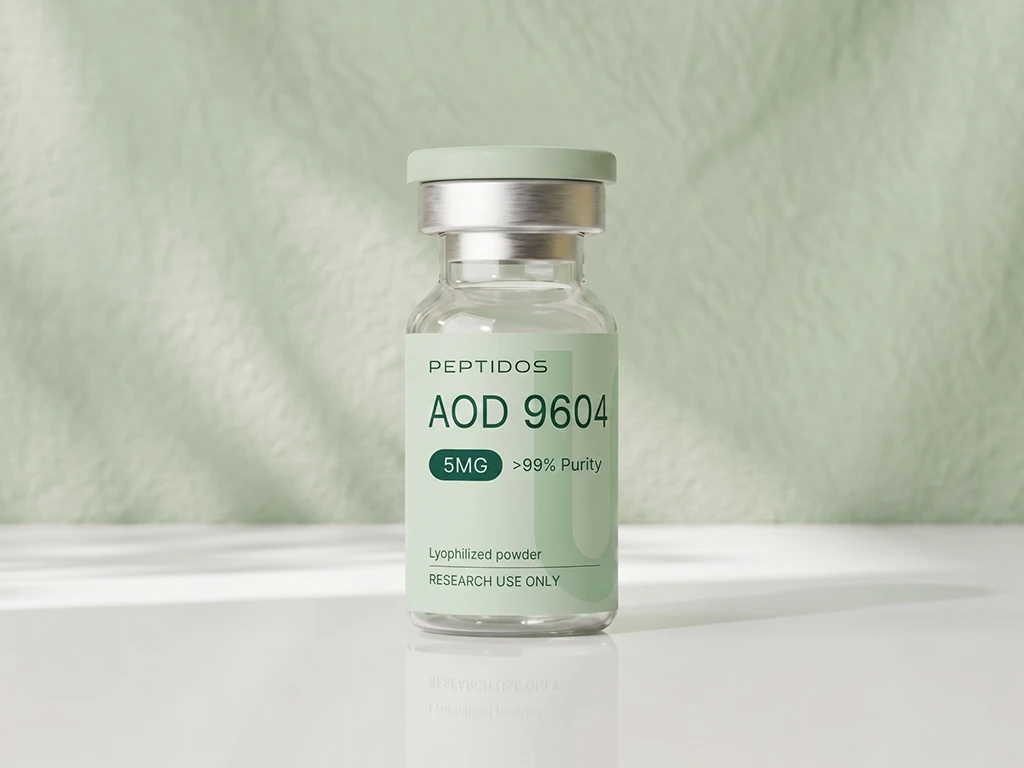
AOD 9604
Synthetic peptide fragment derived from human growth hormone, investigated in laboratory research for its effects on lipid metabolism and lipolytic pathways.
Only 3 left in stock
Low stock - this product is selling out fast
What Is AOD 9604?
AOD 9604 (Anti-Obesity Drug 9604) is a synthetic peptide consisting of 16 amino acids, modeled on the C-terminal fragment of human growth hormone (hGH 177–191) with an additional tyrosine residue at the N-terminus. Originally developed at Monash University in Australia, it has been investigated in preclinical and clinical research for its ability to influence lipolysis and fat oxidation independently of growth-promoting and insulin-related effects associated with full-length hGH.
Unlike intact growth hormone, AOD 9604 has been reported in research models to act on fat metabolism without raising IGF-1 levels, altering insulin sensitivity, or stimulating skeletal growth (Heffernan et al., 2001). This selective profile has made it a subject of interest in studies on obesity, metabolic regulation, and more recently, cartilage and joint repair.
Mechanism of Action
AOD 9604 is studied for its capacity to stimulate lipolysis (the breakdown of triglycerides) and inhibit lipogenesis (the formation of new fat cells), with research suggesting involvement of β3-adrenergic receptor pathways in adipocytes (Ng et al., 2000). The peptide is believed to mimic the lipolytic activity of the parent hGH molecule while bypassing its broader endocrine effects, providing a more targeted mechanism for investigating fat metabolism in research models.
Research Use Only
AOD 9604 supplied by Peptidos.eu is intended exclusively for laboratory and scientific research. It is not approved for human or animal consumption and must not be used as a medicine or diagnostic tool.
- Chemical name
- AOD 9604 (Anti-Obesity Drug 9604 / hGH Fragment 176–191 analog)
- Purity
- 99.22%
- Molecular formula
- C₇₈H₁₂₃N₂₃O₂₃S₂
- Amino acid sequence
- Tyr-Leu-Arg-Ile-Val-Gln-Cys-Arg-Ser-Val-Glu-Gly-Ser-Cys-Gly-Phe (disulfide bridge between Cys⁷–Cys¹⁴)
- CAS number
- 221231-10-3
- Molecular weight
- 1815.1 g/mol
- Number of amino acids
- 16
- Appearance
- White to off-white lyophilized powder.
- Solubility / reconstitution
- Water-soluble. Reconstitute in bacteriostatic or sterile water; dissolves readily to a clear solution.
- Storage
- Stable for 36 months (lyophilized, 2–8°C). After reconstitution store at 4°C and use within ~2 weeks.
- Ng, F. M., et al. (2000). Metabolic studies of a synthetic lipolytic domain (AOD9401) of human growth hormone. Hormone Research, 53(6), 274–278.
- Heffernan, M., et al. (2001). The effects of human GH and its lipolytic fragment (AOD9604) on lipid metabolism following chronic treatment in obese mice and β3-AR knock-out mice. Endocrinology, 142(12), 5182–5189.
- Stier, H., et al. (2013). Safety and tolerability of the hexadecapeptide AOD9604 in humans. Journal of Endocrinology, Diabetes & Obesity, 1(2), 1008.
- Ng, F. M., & Bornstein, J. (1978). Hyperglycemic action of synthetic C-terminal fragments of human growth hormone. American Journal of Physiology, 234(5), E521–E526.
- Kwon, D. R., et al. (2015). Therapeutic effects of AOD9604 with or without hyaluronic acid injections in a rabbit model of collagenase-induced osteoarthritis. PLOS ONE, 10(8), e0136055.
- Heffernan, M. A., et al. (2000). Increase of fat oxidation and weight loss in obese mice caused by chronic treatment with human growth hormone or a modified C-terminal fragment. International Journal of Obesity, 24(6), 757–764.
- Wu, Z., et al. (1993). Identification of the lipolytic domain of human growth hormone. Biochemical and Biophysical Research Communications, 195(2), 1110–1116.
Disclaimer
The products offered by peptidos.eu are intended exclusively for research and laboratory use and are sold only to qualified professionals, institutions, or authorized entities. These products are not intended for human or veterinary consumption, nor for any application involving living organisms, including — but not limited to — diagnostic, therapeutic, or recreational purposes.
By Making a Purchase, the Customer Declares that:
They are a qualified professional or entity, possessing the necessary competence, training, and facilities for the safe handling of chemical reagents;
They will use the product in full compliance with all applicable local, national, and European Union laws and regulations;
They will adopt appropriate safety measures during all stages of handling, storage, and disposal.
Prohibited Uses
The product must not be used as an Active Pharmaceutical Ingredient (API) in the manufacturing or preparation of medicines intended for humans or animals;
Any direct administration or use on humans or animals is strictly prohibited;
Peptidos.eu does not endorse or permit the use of its products for the production, testing, or development of illegal substances.
Liability
The purchaser assumes full responsibility for the handling, storage, and use of the product in safe conditions and in compliance with the law.
Peptidos.eu shall not be held liable for any direct or indirect damages arising from improper use, incorrect storage, or unauthorized use of the product.
Peptidos.eu reserves the right to refuse the sale to any individual or entity suspected of improper use of its products.
In case of doubts regarding the safe and lawful use of the product, it is recommended to consult a qualified professional experienced in laboratory research.
Regulatory Compliance
Peptidos.eu does not claim or imply that its products are approved by the European Medicines Agency (EMA), the Food and Drug Administration (FDA), or any other regulatory authority. All information provided is for informational and scientific purposes only. These products are not intended to diagnose, treat, cure, or prevent any disease.
Related products
The European Standard for Research Peptides
Born in Scandinavia. Built on the principle that research-grade means exactly that. Why researchers choose Peptidos:
- High purity
- Batch-to-batch consistency
- Most comprehensive testing available
- Professional support from people who understand