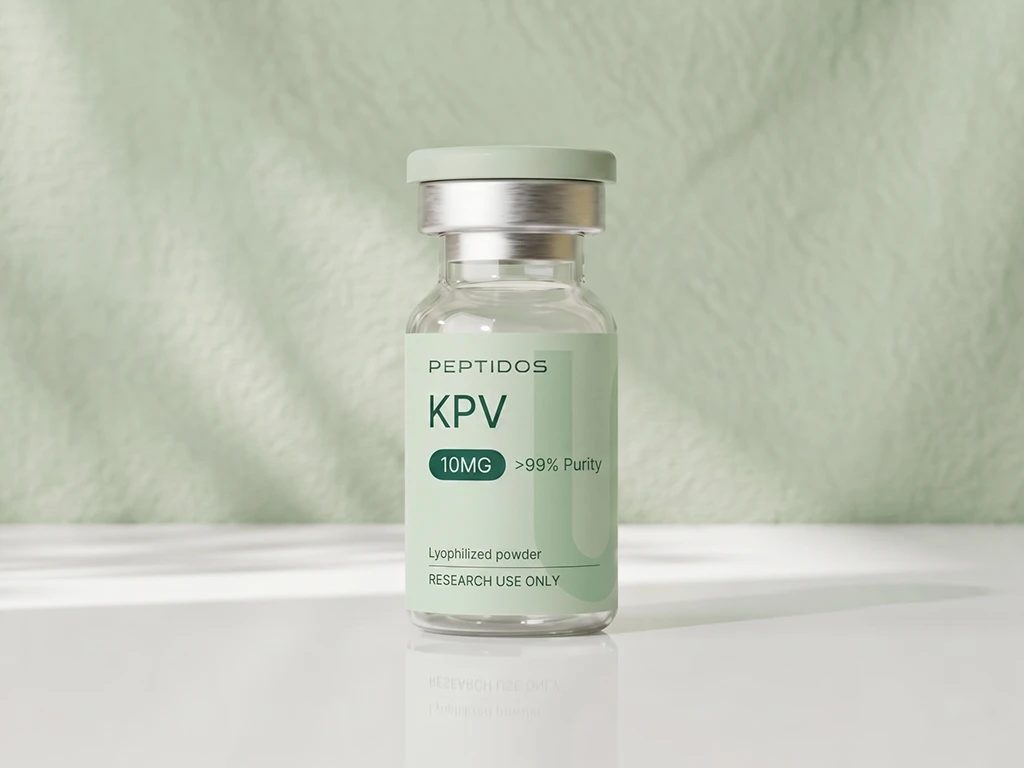
KPV
Synthetic tripeptide composed of lysine, proline, and valine, widely studied for its anti-inflammatory and antimicrobial properties in regenerative and immunity research.
What Is KPV?
KPV (Lys-Pro-Val) is a synthetic tripeptide corresponding to amino acids 11–13 of α-melanocyte-stimulating hormone (α-MSH). Despite its small size, it retains much of the anti-inflammatory activity of the parent hormone while lacking its pigmentary effects, making it a focal point of preclinical research into inflammation, mucosal integrity, and host-defense mechanisms (Brzoska et al., 2008).
As a research compound, KPV is studied for its ability to modulate immune signaling, reduce pro-inflammatory cytokine output, and exert direct antimicrobial activity against a range of bacterial and fungal strains. Its low molecular weight and stability give it favorable characteristics for both systemic and topical experimental models.
Mechanism of Action
KPV is reported to suppress key inflammatory pathways, most notably NF-κB signaling, leading to downregulation of cytokines such as TNF-α, IL-1β, IL-6, and IL-8 (Mandrika et al., 2001; Kannengiesser et al., 2008). Cellular uptake is mediated in part by the PepT1 transporter, which is upregulated in inflamed intestinal epithelium — providing a degree of site-specific delivery in colitis models (Dalmasso et al., 2008). KPV also exhibits melanocortin-receptor-independent activity, distinguishing it from longer α-MSH-derived peptides.
Research Use Only
KPV supplied by Peptidos.eu is intended exclusively for laboratory and scientific research. It is not approved for human or animal consumption and must not be used as a medicine or diagnostic tool.
- Chemical name
- KPV (Lysine-Proline-Valine Tripeptide)
- Purity
- 98.592%
- Molecular formula
- C₁₆H₃₀N₄O₄
- Amino acid sequence
- Lys-Pro-Val
- CAS number
- 67727-97-1
- Molecular weight
- 342.43 g/mol
- Number of amino acids
- 3
- Appearance
- White to off-white lyophilized powder.
- Solubility / reconstitution
- Highly water-soluble. Reconstitute in bacteriostatic water; dissolves readily to a clear solution.
- Storage
- Stable for 36 months (lyophilized, 2–8°C). After reconstitution store at 4°C and use within ~2 weeks.
- Brzoska, T., Luger, T. A., Maaser, C., Abels, C., & Böhm, M. (2008). α-Melanocyte-stimulating hormone and related tripeptides: biochemistry, antiinflammatory and protective effects in vitro and in vivo, and future perspectives for the treatment of immune-mediated inflammatory diseases. Endocrine Reviews, 29(5), 581–602.
- Kannengiesser, K., Maaser, C., Heidemann, J., Luegering, A., Ross, M., Brzoska, T., Bohm, M., Luger, T. A., Domschke, W., & Kucharzik, T. (2008). Melanocortin-derived tripeptide KPV has anti-inflammatory potential in murine models of inflammatory bowel disease. Inflammatory Bowel Diseases, 14(3), 324–331.
- Dalmasso, G., Charrier-Hisamuddin, L., Nguyen, H. T. T., Yan, Y., Sitaraman, S., & Merlin, D. (2008). PepT1-mediated tripeptide KPV uptake reduces intestinal inflammation. Gastroenterology, 134(1), 166–178.
- Mandrika, I., Muceniece, R., & Wikberg, J. E. S. (2001). Effects of melanocortin peptides on lipopolysaccharide/interferon-γ-induced NF-κB DNA binding and nitric oxide production in macrophage-like RAW 264.7 cells: evidence for dual mechanisms of action. Biochemical Pharmacology, 61(5), 613–621.
- Cutuli, M., Cristiani, S., Lipton, J. M., & Catania, A. (2000). Antimicrobial effects of α-MSH peptides. Journal of Leukocyte Biology, 67(2), 233–239.
- Luger, T. A., & Brzoska, T. (2007). α-MSH related peptides: a new class of anti-inflammatory and immunomodulating drugs. Annals of the Rheumatic Diseases, 66(Suppl 3), iii52–iii55.
- Catania, A., Gatti, S., Colombo, G., & Lipton, J. M. (2004). Targeting melanocortin receptors as a novel strategy to control inflammation. Pharmacological Reviews, 56(1), 1–29.
- Hiltz, M. E., & Lipton, J. M. (1990). Antiinflammatory activity of a COOH-terminal fragment of the neuropeptide α-MSH. FASEB Journal, 4(8), 2627–2628.
- Getting, S. J., Schiöth, H. B., & Perretti, M. (2003). Dissection of the anti-inflammatory effect of the core and C-terminal (KPV) α-melanocyte-stimulating hormone peptides. Journal of Pharmacology and Experimental Therapeutics, 306(2), 631–637.
- Bettenworth, D., Buyse, M., Böhm, M., Mennigen, R., Czorniak, I., Kannengiesser, K., Brzoska, T., Luger, T. A., Kucharzik, T., Domschke, W., Merlin, D., & Lügering, A. (2011). The tripeptide KPV promotes intestinal epithelial wound healing in vitro through interaction with the aminopeptidase N. PLoS ONE, 6(7), e22366.
Disclaimer
The products offered by peptidos.eu are intended exclusively for research and laboratory use and are sold only to qualified professionals, institutions, or authorized entities. These products are not intended for human or veterinary consumption, nor for any application involving living organisms, including — but not limited to — diagnostic, therapeutic, or recreational purposes.
By Making a Purchase, the Customer Declares that:
They are a qualified professional or entity, possessing the necessary competence, training, and facilities for the safe handling of chemical reagents;
They will use the product in full compliance with all applicable local, national, and European Union laws and regulations;
They will adopt appropriate safety measures during all stages of handling, storage, and disposal.
Prohibited Uses
The product must not be used as an Active Pharmaceutical Ingredient (API) in the manufacturing or preparation of medicines intended for humans or animals;
Any direct administration or use on humans or animals is strictly prohibited;
Peptidos.eu does not endorse or permit the use of its products for the production, testing, or development of illegal substances.
Liability
The purchaser assumes full responsibility for the handling, storage, and use of the product in safe conditions and in compliance with the law.
Peptidos.eu shall not be held liable for any direct or indirect damages arising from improper use, incorrect storage, or unauthorized use of the product.
Peptidos.eu reserves the right to refuse the sale to any individual or entity suspected of improper use of its products.
In case of doubts regarding the safe and lawful use of the product, it is recommended to consult a qualified professional experienced in laboratory research.
Regulatory Compliance
Peptidos.eu does not claim or imply that its products are approved by the European Medicines Agency (EMA), the Food and Drug Administration (FDA), or any other regulatory authority. All information provided is for informational and scientific purposes only. These products are not intended to diagnose, treat, cure, or prevent any disease.
Related products
The European Standard for Research Peptides
Born in Scandinavia. Built on the principle that research-grade means exactly that. Why researchers choose Peptidos:
- High purity
- Batch-to-batch consistency
- Most comprehensive testing available
- Professional support from people who understand