MOTS-c
Peptide encoded within the 12S rRNA gene, extensively studied for its role in metabolic regulation, exercise physiology, and cellular energy homeostasis research.
What Is MOTS-c?
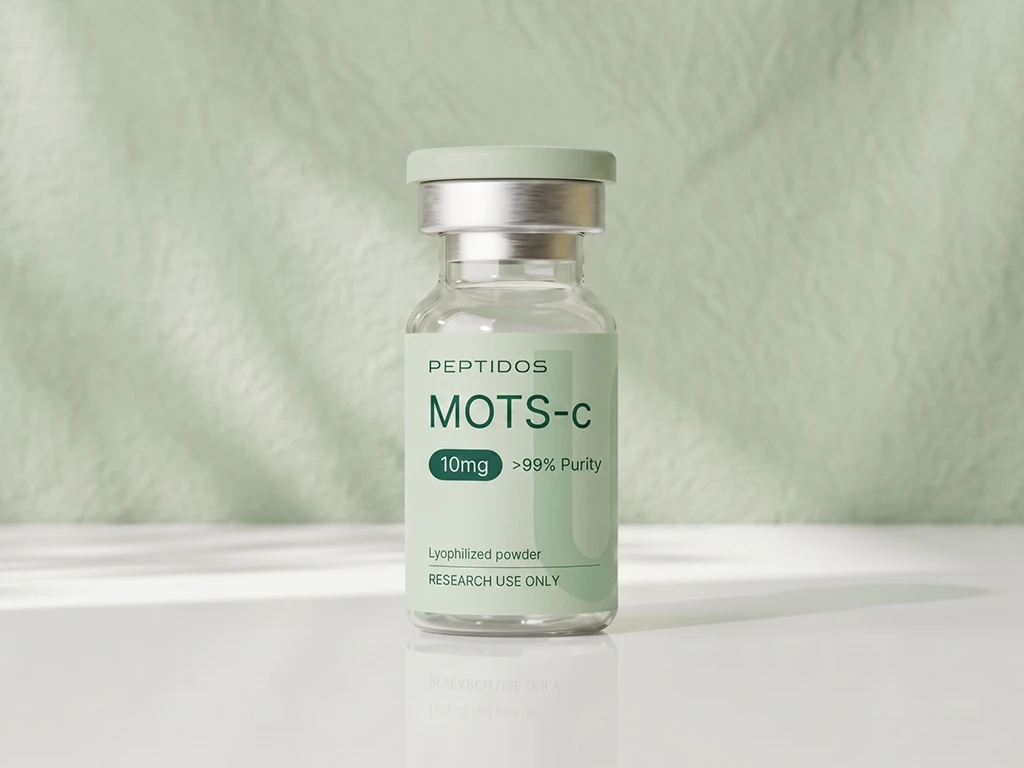
MOTS-c (Mitochondrial Open Reading frame of the 12S rRNA-c) is a 16-amino acid peptide encoded within the mitochondrial genome, specifically inside the 12S rRNA gene. As a research compound, it has gained considerable scientific attention for its role as a mitochondrial-derived signaling molecule, with extensive documentation in preclinical and cellular models of metabolism, aging, and physical performance.
Its underlying biological role centers on cellular energy regulation and metabolic homeostasis. Studies indicate that MOTS-c modulates glucose metabolism, enhances insulin sensitivity, and influences the methionine-folate cycle — processes central to mitochondrial function, muscle performance, and adaptive responses to metabolic stress (Lee et al., 2015).
Mechanism of Action
MOTS-c is studied for its ability to activate AMP-activated protein kinase (AMPK), a master regulator of cellular energy balance (Lee et al., 2015). Under metabolic stress, MOTS-c translocates from the mitochondria to the nucleus, where it regulates nuclear gene expression involved in antioxidant and metabolic responses (Kim et al., 2018). Through these pathways, it supports glucose uptake, fatty acid oxidation, and mitochondrial biogenesis.
Research Use Only
MOTS-c supplied by Peptidos.eu is intended exclusively for laboratory and scientific research. It is not approved for human or animal consumption and must not be used as a medicine or diagnostic tool.
- Chemical name
- MOTS-c (Mitochondrial Open Reading frame of the 12S rRNA-c)
- Purity
- 99.245%
- Molecular formula
- C₁₀₁H₁₅₂N₂₈O₂₂S₂
- Amino acid sequence
- Met-Arg-Trp-Gln-Glu-Met-Gly-Tyr-Ile-Phe-Tyr-Pro-Arg-Lys-Leu-Arg
- CAS number
- 1627580-64-6
- Molecular weight
- 2174.59 g/mol
- Number of amino acids
- 16
- Appearance
- White to off-white lyophilized powder.
- Solubility / reconstitution
- Highly water-soluble. Reconstitute in bacteriostatic or sterile water; dissolves readily to a clear solution.
- Storage
- Stable for 36 months (lyophilized, ≤ -18°C). After reconstitution store at 2–8°C and use within ~7 days; avoid freeze-thaw cycles.

- Lee, C., et al. (2015). The mitochondrial-derived peptide MOTS-c promotes metabolic homeostasis and reduces obesity and insulin resistance. Cell Metabolism, 21(3), 443–454.
- Reynolds, J. C., et al. (2021). MOTS-c is an exercise-induced mitochondrial-encoded regulator of age-dependent physical decline and muscle homeostasis. Nature Communications, 12(1), 470.
- Kim, S. J., et al. (2018). The mitochondrial-encoded peptide MOTS-c translocates to the nucleus to regulate nuclear gene expression in response to metabolic stress. Cell Metabolism, 28(3), 516–524.
- Lu, H., et al. (2019). MOTS-c peptide regulates adipose homeostasis to prevent ovariectomy-induced metabolic dysfunction. Journal of Molecular Medicine, 97(4), 473–485.
- Hu, B. T., & Chen, W. Z. (2018). MOTS-c improves osteoporosis by promoting osteogenic differentiation of bone marrow mesenchymal stem cells via TGF-β/Smad pathway. European Review for Medical and Pharmacological Sciences, 22(21), 7156–7163.
- Cataldo, L. R., et al. (2018). Plasma MOTS-c levels are associated with insulin sensitivity in lean but not in obese individuals. Journal of Investigative Medicine, 66(6), 1019–1022.
- Kong, B. S., et al. (2018). Mitochondrial-encoded MOTS-c prevents pancreatic islet destruction in autoimmune diabetes. Cell Reports, 22(5), 1142–1153.
- Zempo, H., et al. (2021). A pro-diabetogenic mtDNA polymorphism in the mitochondrial-derived peptide, MOTS-c. Aging, 13(2), 1692–1717.
- Ramanjaneya, M., et al. (2019). Mitochondrial-derived peptides are down regulated in diabetes subjects. Frontiers in Endocrinology, 10, 331.
- Merry, T. L., et al. (2020). Mitochondrial-derived peptides in energy metabolism. American Journal of Physiology-Endocrinology and Metabolism, 319(4), E659–E666.
Disclaimer
The products offered by peptidos.eu are intended exclusively for research and laboratory use and are sold only to qualified professionals, institutions, or authorized entities. These products are not intended for human or veterinary consumption, nor for any application involving living organisms, including — but not limited to — diagnostic, therapeutic, or recreational purposes.
By Making a Purchase, the Customer Declares that:
They are a qualified professional or entity, possessing the necessary competence, training, and facilities for the safe handling of chemical reagents;
They will use the product in full compliance with all applicable local, national, and European Union laws and regulations;
They will adopt appropriate safety measures during all stages of handling, storage, and disposal.
Prohibited Uses
The product must not be used as an Active Pharmaceutical Ingredient (API) in the manufacturing or preparation of medicines intended for humans or animals;
Any direct administration or use on humans or animals is strictly prohibited;
Peptidos.eu does not endorse or permit the use of its products for the production, testing, or development of illegal substances.
Liability
The purchaser assumes full responsibility for the handling, storage, and use of the product in safe conditions and in compliance with the law.
Peptidos.eu shall not be held liable for any direct or indirect damages arising from improper use, incorrect storage, or unauthorized use of the product.
Peptidos.eu reserves the right to refuse the sale to any individual or entity suspected of improper use of its products.
In case of doubts regarding the safe and lawful use of the product, it is recommended to consult a qualified professional experienced in laboratory research.
Regulatory Compliance
Peptidos.eu does not claim or imply that its products are approved by the European Medicines Agency (EMA), the Food and Drug Administration (FDA), or any other regulatory authority. All information provided is for informational and scientific purposes only. These products are not intended to diagnose, treat, cure, or prevent any disease.
Related products


The European Standard for Research Peptides
Born in Scandinavia. Built on the principle that research-grade means exactly that. Why researchers choose Peptidos:
- High purity
- Batch-to-batch consistency
- Most comprehensive testing available
- Professional support from people who understand