NAD+: The Molecule You Can't Live Without (and Why It Disappears as You Age)
A research-based comparison of NMN, NR, and NAD+ injections — what actually works, what's hype, and what science still can't agree on in 2026.
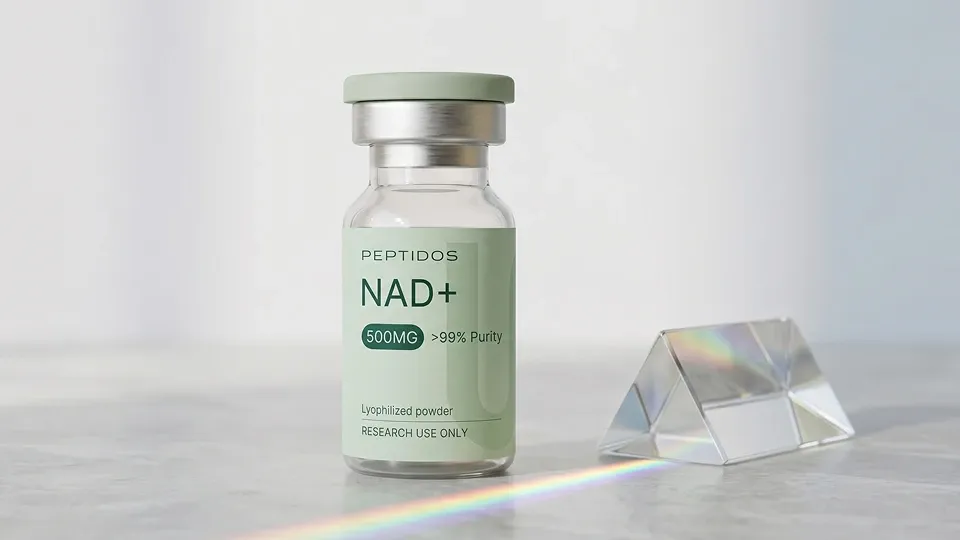
Table of contents
If you stopped making NAD+ right now, you'd be dead in under a minute. It's that essential. Your body burns through it constantly to fuel roughly 400 different chemical reactions — from turning food into energy to repairing damaged DNA. And yet, by the time you turn 50, your levels have roughly halved. By 80, they're a fraction of what they were in childhood. In this article, the Peptidos Research Team breaks down the three most popular ways people are trying to top up their NAD+ tanks — NMN, NR, and direct NAD+ injections — and what the science actually says about each.
What Is NAD+, Really?
NAD+ stands for nicotinamide adenine dinucleotide, but the name is the least interesting thing about it. Think of NAD+ as the cellular currency of life. Every mitochondrion in your body — those microscopic power plants packed inside your cells — needs NAD+ to convert food and oxygen into usable energy. Without it, the lights go out.
But NAD+ does much more than power metabolism. It activates a family of proteins called sirtuins, sometimes called "longevity genes," which protect chromosomes, repair DNA, and silence cellular damage. It feeds another group of repair enzymes called PARPs, which spring into action whenever your DNA gets nicked or broken. It even helps regulate your circadian rhythm — research has shown that artificially disrupting the NAD+ cycle throws off the body's internal clock, which is one reason some users report sleep changes when they start supplementing late in the day.
Here's where it gets uncomfortable: NAD+ levels collapse with age. Skin samples show roughly a 70% drop in older adults compared to young people. Liver NAD+ falls by about 30% between the ages of 45 and 60. MRI studies of the brain reveal a 10–25% decline from adolescence into old age. And it's a double whammy — your body makes less of it as you get older, and an enzyme called CD38 simultaneously starts chewing through your existing supply at a faster rate.
This decline tracks closely with virtually every age-related condition we know about: declining energy, slower recovery, fading cognition, weaker mitochondria, and accumulating DNA damage. Which is why, over the past decade, an entire industry has sprung up around the idea of putting NAD+ back.
Why You Can't Just Eat Your Way Out of It
NAD+ is technically present in food. Broccoli, edamame, beef, and milk all contain trace amounts of its precursors. But the numbers are brutal: you'd need to eat about 40 pounds of broccoli to get the dose used in a typical NMN clinical trial. Milk contains roughly 1 mg of NR per liter — meaning a daily research dose would require drinking around 300 liters.
This is why supplementation became the obvious workaround. The question is which form actually works.
Option 1: NMN (Nicotinamide Mononucleotide)
NMN is one biochemical step away from NAD+. Your cells can take it up through dedicated transporters and convert it almost immediately. Of the three options, it's been the most-studied in human trials over the last few years.
Recent clinical research has been genuinely interesting. A 2024 study found that 600–900 mg of NMN per day raised blood NAD+ levels in a dose-dependent way, and the increases correlated with measurable improvements in walking distance and self-reported quality of life in middle-aged adults. A 2025 Japanese study in older men showed that afternoon NMN dosing improved lower-limb function and reduced daytime drowsiness. Another 2025 trial in postmenopausal women with prediabetes found NMN improved muscle insulin sensitivity. There's even a small but charming 2025 study showing that 500 mg/day of NMN for 12 weeks made hair appear visibly thicker in middle-aged women.
The catch: oral NMN bioavailability is estimated at only 20–40%. Your gut and liver chew through a chunk of every dose before it ever reaches the rest of your body. NMN also varies a lot person-to-person — your gut microbiome, baseline NAD+ levels, and genetics all influence how much actually ends up doing useful work.
Option 2: NR (Nicotinamide Riboside)
NR is two steps away from NAD+ instead of one. It's a modified form of vitamin B3 and was the first NAD+ precursor to hit the supplement market at scale. NR has the longest human safety record of the three options — it's been studied in trials at doses ranging from 100 to 2,000 mg per day for up to 12 weeks, with consistently clean safety profiles.
What makes NR particularly interesting is the brain. A 2023 study used extracellular vesicle analysis (essentially looking at tiny biological packages released by neurons) to show that oral NR actually raises NAD+ levels inside brain cells and shifts biomarkers linked to neurodegenerative disease. Some researchers argue NR crosses the blood–brain barrier more efficiently than NMN, making it the better candidate for cognitive applications. Other research has shown NR can increase fat-free body mass in adults with obesity, though it didn't move the needle on insulin sensitivity in those same trials.
NR's downside is the same as NMN's — modest bioavailability, and an extra metabolic step before it becomes usable NAD+.
Option 3: NAD+ Injections (and the Big Scientific Argument)
This is where things get controversial. Direct NAD+ injections — whether intravenous, intramuscular, or subcutaneous — bypass the digestive system entirely. IV NAD+ achieves close to 100% bioavailability on paper, with peak plasma levels roughly six times higher than equivalent oral dosing. Subcutaneous injections offer a middle ground: high absorption, slower release, and the convenience of self-administration at home.
Sounds like a knockout win for injections, right? Not so fast.
Here's the scientific debate that the wellness industry usually glosses over: the NAD+ molecule may simply be too large to enter cells directly. Dr. Eric Verdin, president of the Buck Institute for Research on Aging, has publicly questioned whether injected NAD+ ever reaches the inside of cells where it would actually do its job — or whether it just gets broken down into smaller fragments in the bloodstream first. Those fragments (NMN, NR, and nicotinamide) are then taken up by cells and reassembled. If that's true, IV NAD+ might essentially be a more expensive, more invasive way of doing what oral precursors already do.
Real-world data suggests injected NAD+ does something — users frequently report sharper focus, better mood, and faster recovery, and small clinical observations support sustained energy improvements.
There are also practical concerns. Injectable NAD+ isn't FDA-approved as a drug; it's compounded by specialty pharmacies, and quality varies dramatically. IV infusions can cause chest tightness, nausea, and a racing heart — usually mild and temporary, but enough that experienced clinics now run infusions slowly over hours. Costs run $100–$700 per month.
Subcutaneous injections of NR specifically (rather than NAD+ itself) are now being studied in a Phase 1 safety trial that started in late 2025, which may finally bring some clarity to the injection-vs-oral question.
So Which One Should You Actually Care About?
Honestly, the answer is "it depends on what you're optimizing for."
If you want the strongest body of human safety data and the cheapest entry point, NR is the most road-tested. If you want the most direct precursor with the freshest research signals on metabolic and physical performance, NMN has more recent momentum. If you want maximum blood-level NAD+ as fast as possible and you're willing to pay for it, injections deliver the highest plasma concentrations.
What does seem clear: blood NAD+ is not the same as cellular NAD+, and cellular NAD+ is what actually matters. Several leading labs now recommend testing intracellular NAD+ before and after supplementation rather than relying on subjective feelings.
Regulatory Status
NMN and NR are sold as dietary supplements in most of Europe and were available as such in the US until the FDA reclassified NMN as an "investigational drug" in 2022, which complicated its supplement status. NR remains widely available.
The World Anti-Doping Agency has not banned NAD+ precursors as of 2026, though that may change as evidence on athletic recovery accumulates.
Key Takeaway
NAD+ is one of the most important molecules in your body, and topping it back up after middle age is one of the most exciting frontiers in longevity science. NR has the longest safety track record. NMN has the freshest momentum and the strongest recent human data. Direct NAD+ injections offer dramatic plasma boosts. The honest answer in 2026 is that all three approaches show promise, none are slam-dunks, and the field is moving fast.
References
- Yang, Y. et al. (2025). "An Updated Review on the Mechanisms, Pre-Clinical and Clinical Comparisons of Nicotinamide Mononucleotide (NMN) and Nicotinamide Riboside (NR)." Food Frontiers, Wiley.
- Song, Q. et al. (2023). "The Safety and Antiaging Effects of Nicotinamide Mononucleotide in Human Clinical Trials: an Update." Advances in Nutrition, PMC10721522.
- Nadeeshani, H. et al. (2024). "Nicotinamide Mononucleotide Supplementation: Understanding Metabolic Variability and Clinical Implications." Metabolites, PMC11205942.
- Igarashi, M. et al. (2022). "Chronic nicotinamide mononucleotide supplementation elevates blood nicotinamide adenine dinucleotide levels and alters muscle function in healthy older men." npj Aging, PMC9158788.
- Pencina, K.M. et al. (2024). "Towards personalized nicotinamide mononucleotide (NMN) supplementation: NAD concentration." medRxiv, 2024.02.19.24303025.
- Vreones, M. et al. (2023). "Oral nicotinamide riboside raises NAD+ and lowers biomarkers of neurodegenerative pathology in plasma extracellular vesicles." Aging Cell.
- Imai, S. & Guarente, L. (2014). "NAD+ and sirtuins in aging and disease." Trends in Cell Biology, PMC5514996.
- Sinclair, D.A. & LaPlante, M.D. (2019). Lifespan: Why We Age — and Why We Don't Have To. Atria Books.
- ChromaDex Inc. (2025). "Randomized, Open-Label, Safety Pilot Study of Multiple Subcutaneous and Intramuscular Injections of Niagen® Plus." ClinicalTrials.gov, NCT07251608.
- U.S. Food and Drug Administration (2025). "Class I Recall — GenoGenix NAD+ Injection: Endotoxin Contamination." FDA Enforcement Report.
- Yoshino, M. et al. (2021). "Nicotinamide mononucleotide increases muscle insulin sensitivity in prediabetic women." Science, 372(6547), 1224–1229.
- Lee, E. & Burgess, K. (2025). "Bioavailability and Tolerability of Intravenous NAD+ Infusion in Adults: A Pharmacokinetic Pilot." Alternative Therapies in Health and Medicine.
- Verdin, E. (2015). "NAD+ in aging, metabolism, and neurodegeneration." Science, 350(6265), 1208–1213.
- Kim, M. et al. (2025). "Oral Supplementation of Nicotinamide Mononucleotide Improves Hair Quality in Middle-Aged Women: A Single-Arm Pilot Study." Journal of Cosmetic Dermatology.
Table of contents
Author

Peptidos
Research Team
We are a Scandinavian longevity research team with 15+ years of combined experience studying peptides' role in aging, cellular health, muscle growth, and cognitive performance.
Sign up to our newsletter