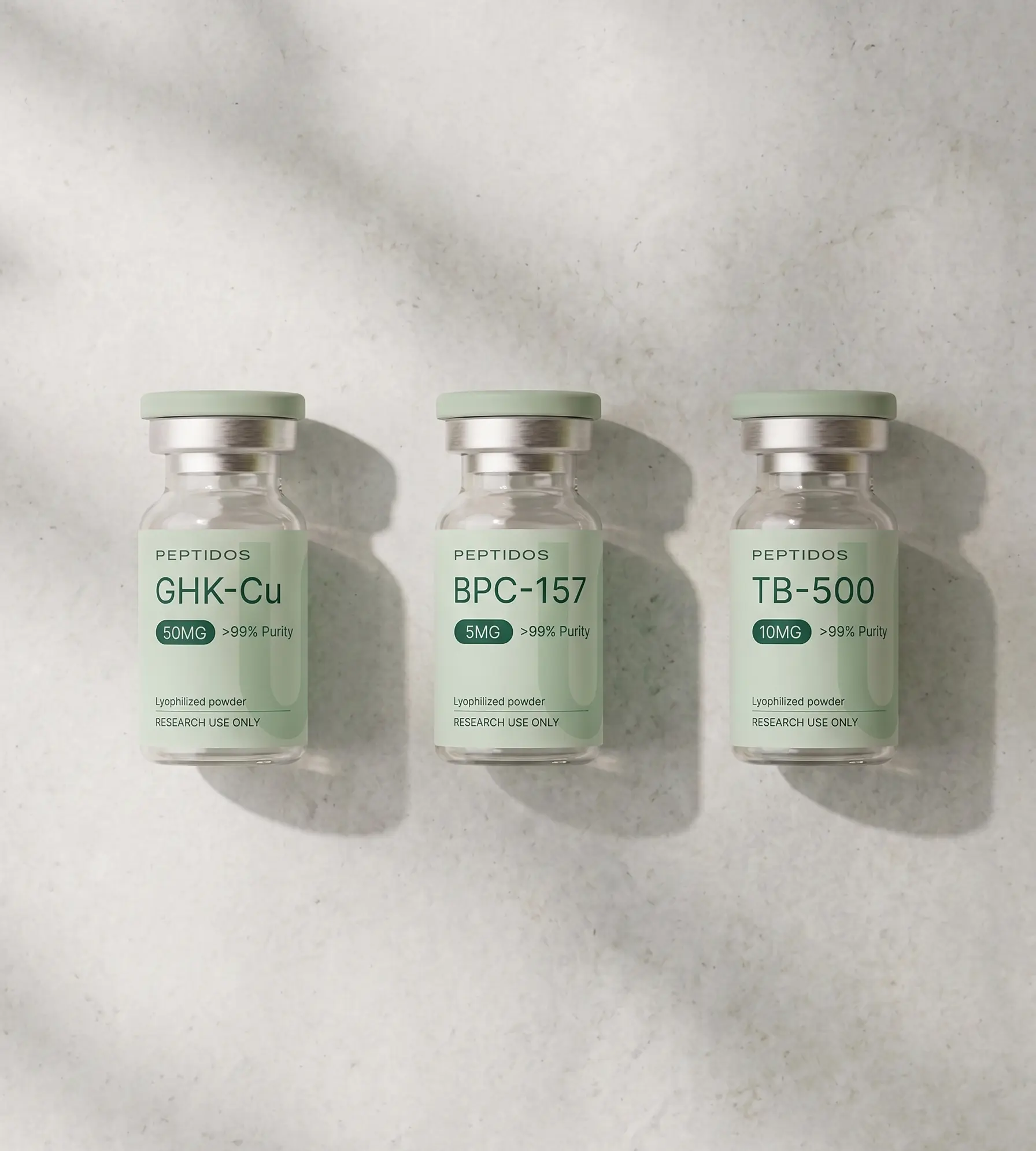
GHK-Cu
Naturally occurring copper-binding tripeptide studied for its role in skin regeneration, collagen synthesis, and gene expression modulation.
What Is GHK-Cu?
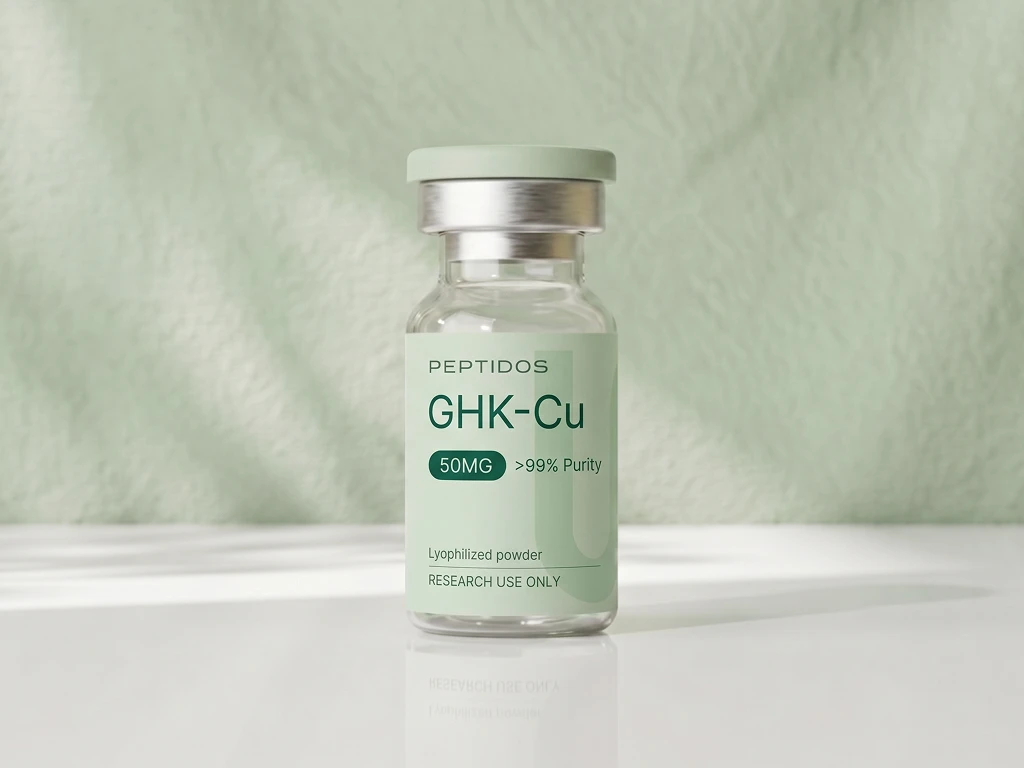
GHK-Cu (Glycyl-L-Histidyl-L-Lysine Copper) is a small, naturally occurring tripeptide complexed with a copper(II) ion, first isolated from human plasma in 1973 by Dr. Loren Pickart. It is also present in saliva and urine, with plasma concentrations declining progressively with age, a trend that correlates with the body's reduced regenerative capacity over time (Pickart & Margolina, 2018).
As a research compound, GHK-Cu has attracted decades of scientific interest for its regenerative, antioxidant, and anti-inflammatory properties, documented across cellular, preclinical, and clinical models. Its biological role centers on copper transport into cells, collagen remodeling, and broad modulation of gene expression, with studies showing GHK-Cu influences the activity of more than 4,000 human genes involved in tissue repair, cellular defense, and matrix remodeling (Pickart & Margolina, 2018).
Mechanism of Action
GHK-Cu's mechanism is twofold. As a copper chelator, it delivers bioavailable Cu(II) to cells, where copper serves as a cofactor for enzymes such as lysyl oxidase and lysyl hydroxylase, both essential for collagen cross-linking and structural stability (Pickart et al., 2015). Independently, GHK-Cu modulates the transcription of genes governing extracellular matrix synthesis, antioxidant defense (SOD, glutathione peroxidase, ferritin), and inflammatory signaling pathways including NF-κB and TGF-β1 (Pickart & Margolina, 2018).
This dual action, combining enzymatic cofactor delivery with transcriptional modulation, underpins GHK-Cu's unusually wide range of documented biological effects.
Research Use Only
GHK-Cu supplied by Peptidos.eu is intended exclusively for laboratory and scientific research. It is not approved for human or animal consumption and must not be used as a medicine or diagnostic tool.
- Chemical name
- GHK-Cu (Copper Tripeptide-1)
- Purity
- 99.533%
- Molecular formula
- C₁₄H₂₃CuN₆O₄
- Amino acid sequence
- Gly-His-Lys
- CAS number
- 89030-95-5
- Molecular weight
- 401.91 g/mol
- Number of amino acids
- 3
- Appearance
- Blue to blue-violet lyophilized powder.
- Solubility / reconstitution
- Highly water-soluble. Reconstitute in bacteriostatic or sterile water; dissolves readily to a clear blue solution. Avoid low-pH diluents and strong reducing agents.
- Storage
- Stable for ~24 months lyophilized at −20 °C, protected from light. After reconstitution, store at 2–8 °C and use within ~2 weeks. Avoid repeated freeze-thaw.
- Pickart, L. (1973). A tripeptide in human serum that promotes the growth of hepatoma cells and the survival of normal hepatocytes. PhD Thesis, University of California, San Francisco.
- Pickart, L., & Thaler, M. M. (1973). Tripeptide in human serum which prolongs survival of normal liver cells and stimulates growth in neoplastic liver. Nature New Biology, 243(124), 85–87.
- Maquart, F. X., Pickart, L., Laurent, M., Gillery, P., Monboisse, J. C., & Borel, J. P. (1988). Stimulation of collagen synthesis in fibroblast cultures by the tripeptide-copper complex glycyl-L-histidyl-L-lysine-Cu2+. FEBS Letters, 238(2), 343–346.
- Pickart, L., Vasquez-Soltero, J. M., & Margolina, A. (2015). GHK peptide as a natural modulator of multiple cellular pathways in skin regeneration. BioMed Research International, 2015, 648108.
- Pickart, L., & Margolina, A. (2018). Regenerative and protective actions of the GHK-Cu peptide in the light of the new gene data. International Journal of Molecular Sciences, 19(7), 1987.
- Pickart, L., Vasquez-Soltero, J. M., & Margolina, A. (2015). GHK-Cu may prevent oxidative stress in skin by regulating copper and modifying expression of numerous antioxidant genes. Cosmetics, 2(3), 236–247.
- Gruchlik, A., Jurzak, M., Chodurek, E., & Dzierzewicz, Z. (2012). Effect of GLY-HIS-LYS and its copper complex on TGF-β secretion in normal human dermal fibroblasts. Acta Poloniae Pharmaceutica, 69(6), 1303–1306.
- Canapp, S. O., Farese, J. P., Schultz, G. S., Gowda, S., Ishak, A. M., Swaim, S. F., Vangilder, J., Lee-Ambrose, L., & Martin, F. G. (2003). The effect of topical tripeptide-copper complex on healing of ischemic open wounds. Veterinary Surgery, 32(6), 515–523.
- Finkley, M. B., Appa, Y., & Bhandarkar, S. (2005). Copper peptide and skin. In Cosmeceuticals and Active Cosmetics: Drugs vs. Cosmetics (2nd ed., pp. 549–563). Taylor & Francis.
Disclaimer
The products offered by peptidos.eu are intended exclusively for research and laboratory use and are sold only to qualified professionals, institutions, or authorized entities. These products are not intended for human or veterinary consumption, nor for any application involving living organisms, including — but not limited to — diagnostic, therapeutic, or recreational purposes.
By Making a Purchase, the Customer Declares that:
They are a qualified professional or entity, possessing the necessary competence, training, and facilities for the safe handling of chemical reagents;
They will use the product in full compliance with all applicable local, national, and European Union laws and regulations;
They will adopt appropriate safety measures during all stages of handling, storage, and disposal.
Prohibited Uses
The product must not be used as an Active Pharmaceutical Ingredient (API) in the manufacturing or preparation of medicines intended for humans or animals;
Any direct administration or use on humans or animals is strictly prohibited;
Peptidos.eu does not endorse or permit the use of its products for the production, testing, or development of illegal substances.
Liability
The purchaser assumes full responsibility for the handling, storage, and use of the product in safe conditions and in compliance with the law.
Peptidos.eu shall not be held liable for any direct or indirect damages arising from improper use, incorrect storage, or unauthorized use of the product.
Peptidos.eu reserves the right to refuse the sale to any individual or entity suspected of improper use of its products.
In case of doubts regarding the safe and lawful use of the product, it is recommended to consult a qualified professional experienced in laboratory research.
Regulatory Compliance
Peptidos.eu does not claim or imply that its products are approved by the European Medicines Agency (EMA), the Food and Drug Administration (FDA), or any other regulatory authority. All information provided is for informational and scientific purposes only. These products are not intended to diagnose, treat, cure, or prevent any disease.
Related products
The European Standard for Research Peptides
Born in Scandinavia. Built on the principle that research-grade means exactly that. Why researchers choose Peptidos:
- High purity
- Batch-to-batch consistency
- Most comprehensive testing available
- Professional support from people who understand