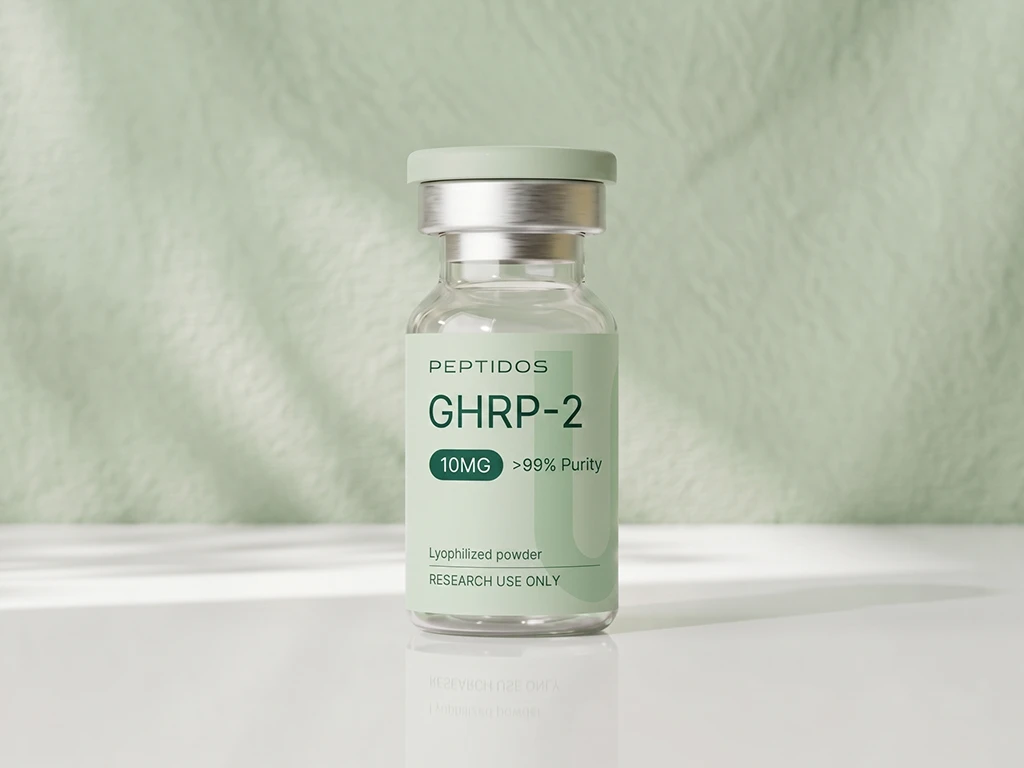
GHRP-2
Synthetic hexapeptide and growth hormone secretagogue, extensively studied for its role in stimulating the body's natural release of growth hormone.
What Is GHRP-2?
GHRP-2 (Growth Hormone Releasing Peptide-2), also known as Pralmorelin, is a synthetic peptide composed of 6 amino acids and a modified analogue of met-enkephalin. As a research compound, it has attracted significant scientific interest for its potent growth hormone-releasing properties, extensively documented in preclinical and clinical research models.
Its underlying biological role relates to activation of the growth hormone secretagogue receptor (GHS-R1a) — the same receptor targeted by the endogenous hormone ghrelin. Studies indicate that GHRP-2 stimulates pulsatile growth hormone (GH) secretion from pituitary somatotrophs, amplifies downstream IGF-1 production, and influences appetite, energy balance, and sleep-related signaling pathways (Bowers et al., 1990; Smith et al., 1996).
Mechanism of Action
GHRP-2 is studied for its ability to act on both the hypothalamus and the anterior pituitary, binding the GHS-R1a receptor to amplify the natural pulsatile release of growth hormone (Bowers, 1996; Camanni et al., 1998). It also partially suppresses somatostatin tone, allowing greater downstream GH output without disrupting the body's natural feedback rhythm.
Research Use Only
GHRP-2 supplied by Peptidos.eu is intended exclusively for laboratory and scientific research. It is not approved for human or animal consumption and must not be used as a medicine or diagnostic tool.
- Chemical name
- GHRP-2 (Pralmorelin)
- Purity
- 99.547%
- Molecular formula
- C₄₅H₅₅N₉O₆
- Amino acid sequence
- D-Ala-D-2-Nal-Ala-Trp-D-Phe-Lys-NH₂
- CAS number
- 158861-67-7
- Molecular weight
- 817.97 g/mol
- Number of amino acids
- 6
- Appearance
- White to off-white lyophilized powder.
- Solubility / reconstitution
- Highly water-soluble. Reconstitute in bacteriostatic water; dissolves readily to a clear solution.
- Storage
- Stable for 36 months (lyophilized, 2–8°C). After reconstitution store at 4°C and use within ~2 weeks.
- Bowers, C. Y., et al. (1984). On the in vitro and in vivo activity of a new synthetic hexapeptide that acts on the pituitary to specifically release growth hormone. Endocrinology, 114(5), 1537–1545.
- Bowers, C. Y., et al. (1990). On the actions of the growth hormone-releasing hexapeptide, GHRP. Endocrinology, 128(4), 2027–2035.
- Smith, R. G., et al. (1996). Peptidomimetic regulation of growth hormone secretion. Endocrine Reviews, 18(5), 621–645.
- Bowers, C. Y. (1996). Xenobiotic growth hormone secretagogues: Growth hormone releasing peptides. Frontiers in Neuroendocrinology, 17(3), 285–344.
- Pihoker, C., et al. (1997). Diagnostic studies with intravenous and intranasal growth hormone-releasing peptide-2 in children of short stature. Journal of Clinical Endocrinology & Metabolism, 82(9), 2987–2992.
- Camanni, F., et al. (1998). Growth hormone-releasing peptides and their analogs. Frontiers in Neuroendocrinology, 19(1), 47–72.
- Bowers, C. Y., et al. (2004). Sustained elevation of pulsatile growth hormone (GH) secretion and insulin-like growth factor I (IGF-I), IGF-binding protein-3 (IGFBP-3), and IGFBP-5 concentrations during 30-day continuous subcutaneous infusion of GH-releasing peptide-2 in older men and women. Journal of Clinical Endocrinology & Metabolism, 89(5), 2290–2300.
- Furuta, S., et al. (2004). Growth hormone (GH) responses to GH-releasing peptide-2 in healthy Japanese adults: Reference values for the diagnosis of GH deficiency. Endocrine Journal, 51(6), 553–559.
- Laferrère, B., et al. (2005). Growth hormone releasing peptide-2 (GHRP-2), like ghrelin, increases food intake in healthy men. Journal of Clinical Endocrinology & Metabolism, 90(2), 611–614.
- Sigalos, J. T., & Pastuszak, A. W. (2018). The safety and efficacy of growth hormone secretagogues. Sexual Medicine Reviews, 6(1), 45–53.
Disclaimer
The products offered by peptidos.eu are intended exclusively for research and laboratory use and are sold only to qualified professionals, institutions, or authorized entities. These products are not intended for human or veterinary consumption, nor for any application involving living organisms, including — but not limited to — diagnostic, therapeutic, or recreational purposes.
By Making a Purchase, the Customer Declares that:
They are a qualified professional or entity, possessing the necessary competence, training, and facilities for the safe handling of chemical reagents;
They will use the product in full compliance with all applicable local, national, and European Union laws and regulations;
They will adopt appropriate safety measures during all stages of handling, storage, and disposal.
Prohibited Uses
The product must not be used as an Active Pharmaceutical Ingredient (API) in the manufacturing or preparation of medicines intended for humans or animals;
Any direct administration or use on humans or animals is strictly prohibited;
Peptidos.eu does not endorse or permit the use of its products for the production, testing, or development of illegal substances.
Liability
The purchaser assumes full responsibility for the handling, storage, and use of the product in safe conditions and in compliance with the law.
Peptidos.eu shall not be held liable for any direct or indirect damages arising from improper use, incorrect storage, or unauthorized use of the product.
Peptidos.eu reserves the right to refuse the sale to any individual or entity suspected of improper use of its products.
In case of doubts regarding the safe and lawful use of the product, it is recommended to consult a qualified professional experienced in laboratory research.
Regulatory Compliance
Peptidos.eu does not claim or imply that its products are approved by the European Medicines Agency (EMA), the Food and Drug Administration (FDA), or any other regulatory authority. All information provided is for informational and scientific purposes only. These products are not intended to diagnose, treat, cure, or prevent any disease.
Related products
The European Standard for Research Peptides
Born in Scandinavia. Built on the principle that research-grade means exactly that. Why researchers choose Peptidos:
- High purity
- Batch-to-batch consistency
- Most comprehensive testing available
- Professional support from people who understand