Tirzepatide Explained: How It Works, Benefits, and Side Effects
A research-based look at how a single molecule hijacking two hunger hormones is producing results that surprised even the scientists who built it — and what's still unknown in 2026.
In late 2025, neurosurgeons at the University of Pennsylvania got a rare and slightly surreal opportunity. A 60-year-old woman with severe obesity, who described constant intrusive thoughts about food, already had electrodes implanted deep in her brain for an unrelated study. She'd been struggling to resist takeout, late-night snacking, and the kind of food obsession that hijacks your day. Then she started tirzepatide. As her dose climbed, something extraordinary happened on the recordings: the electrical activity in her nucleus accumbens — the brain's reward center — went almost completely silent. The food cravings vanished. The neural noise that had run her life for years just stopped.
That's not how most weight loss drugs work. And tirzepatide isn't most weight loss drugs. In this article, the Peptidos Research Team breaks down how this molecule actually works, why it's posting weight loss numbers that startled the field, and where the catches are hiding.
What Tirzepatide Is?
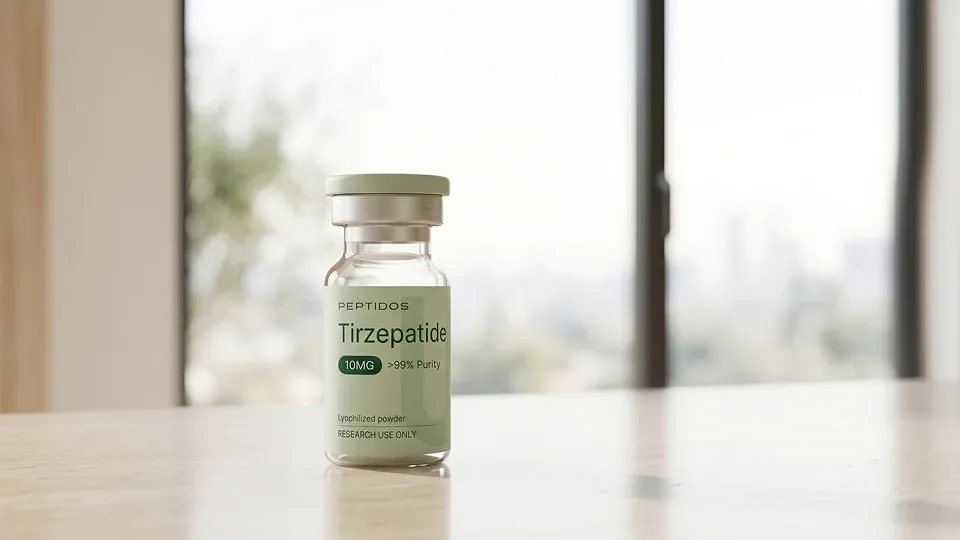
Tirzepatide is a synthetic peptide — a chain of 39 amino acids — with a long fatty acid tail attached to it. That tail lets the molecule cling to a protein in your blood called albumin, which is essentially what gives tirzepatide its 5-day half-life, drastically reducing intake frequancy. Without that tail, your kidneys would flush it out in hours.
But the more interesting thing about tirzepatide is what it imitates. Your gut produces two hormones every time you eat: GLP-1 (glucagon-like peptide-1) and GIP (glucose-dependent insulinotropic polypeptide). Both tell your pancreas to release insulin, your stomach to slow down, and your brain that you've had enough. Most weight loss drugs you've heard of — Ozempic, Wegovy, Mounjaro's older cousin — only mimic GLP-1.
Tirzepatide mimics both. Hence its nickname in the scientific literature: the "twincretin."
Here's the strange part. For decades, GIP was considered a dead end. When researchers infused it into people with type 2 diabetes back in the 1990s, nothing useful happened — their insulin barely budged. The hormone got filed away as biologically interesting but therapeutically pointless. Then someone discovered that GIP and GLP-1 together do something neither does alone. The combined signal hits the pancreas, the brain, and adipose tissue in a coordinated way that's much greater than the sum of its parts. Suddenly the dead-end hormone became half of the most powerful metabolic drug ever developed.
Tirzepatide Weight Loss Numbers Are Unusual
Most weight loss medications, historically, deliver a 5-10% body weight reduction. That's clinically meaningful, but it's not life-changing.
Tirzepatide does not behave like a normal weight loss drug. In the SURMOUNT-1 trial, adults without diabetes taking the highest dose for 72 weeks lost an average of 22.5% of their body weight — roughly 24 kg, or 52 pounds. About 36% of people on that dose lost more than a quarter of their body weight. To put that in perspective: those numbers are getting close to what bariatric surgery achieves.
Then in May 2025, the SURMOUNT-5 trial put tirzepatide head-to-head against semaglutide (Wegovy) — its closest competitor. Tirzepatide produced 20.2% weight loss versus 13.7% for semaglutide. That's about 47% more relative weight loss. Waist circumference dropped 18.4 cm on tirzepatide versus 13.0 cm on semaglutide. And here's something that surprised people: tirzepatide had fewer dropouts from gastrointestinal side effects (2.7%) than semaglutide (5.6%), despite producing more weight loss.
What Else Is Tirzepatide Doing in the Body
Weight loss is the headline, but tirzepatide is doing a lot of other things at the same time, because GIP and GLP-1 receptors are sprinkled across many of your tissues.
- Sleep apnea. The SURMOUNT-OSA trials looked at people with moderate-to-severe obstructive sleep apnea. Tirzepatide cut their apnea events by close to two-thirds. That's the kind of improvement that, if it holds up over time, could meaningfully reduce cardiovascular mortality in this population.
- Cardiovascular risk markers. Blood pressure, triglycerides, inflammatory markers, and atherogenic lipid particles all move in favorable directions. Some of that is from weight loss itself; some appears to be independent of it.
- Fatty liver disease. Tirzepatide reduces liver fat, which matters because metabolic-associated fatty liver disease (now called MAFLD) is becoming one of the most common chronic conditions in developed countries.
- Insulin sensitivity. In postmenopausal women, in people with type 2 diabetes, in adults with obesity — insulin sensitivity improves, and not all of the improvement is explained by the weight loss. The dual receptor activation seems to be doing something to muscle and fat tissue directly.
- Emerging brain research. Animal models and early signals in humans suggest GIP/GLP-1 dual agonism may protect neurons. Whether tirzepatide ends up being part of the Alzheimer's or Parkinson's toolkit is one of the most-watched questions in the field right now.
Where It Gets Complicated
Tirzepatide is genuinely impressive, but it's not magic. A few honest caveats:
- Gastrointestinal side effects are real. Nausea, vomiting, constipation, and diarrhea are the most common complaints, especially during dose escalation. They usually fade, but some people can't get past them. The drug works partly by slowing stomach emptying, which is also why it makes some people feel uncomfortable.
- Muscle loss is more nuanced than the headlines suggest. The SURMOUNT-1 body composition substudy found that about 74% of the weight lost on tirzepatide was fat and 26% was lean mass — almost identical to the ratio in placebo participants who lost much less weight. So you're not losing a disproportionate amount of muscle; you're just losing more total weight. Still, resistance training and adequate protein during treatment matter more than ever.
- Stop the drug, regain the weight. The SURMOUNT-4 trial made this brutally clear. People who lost an average of 21% of their body weight during the lead-in, then switched to placebo, regained an average of 14% of body weight over the next year. People who stayed on tirzepatide kept losing. This is not a 12-week intervention.
- The black box warning. Tirzepatide carries a boxed warning about thyroid C-cell tumors based on rodent studies. It hasn't been linked to human thyroid cancer in clinical trials, but people with a personal or family history of medullary thyroid carcinoma or MEN-2 syndrome shouldn't take it.
Regulatory Status
Tirzepatide was approved by the FDA for type 2 diabetes in May 2022 (under the brand name Mounjaro), then approved for chronic weight management in November 2023 (under the brand name Zepbound). It's now also approved for obstructive sleep apnea in adults with obesity. The European Medicines Agency followed similar approvals.
The World Anti-Doping Agency has not banned it as of 2026, though that may evolve as more is understood about its effects on recovery and body composition in athletes.
Key Takeaway on Tirzepatide
Tirzepatide is one of the most consequential metabolic drugs ever brought to market. Its dual mechanism produces weight loss numbers that, until recently, were only achievable with surgery. It's also improving sleep apnea, liver fat, blood pressure, and insulin sensitivity in ways that go beyond what weight loss alone explains. The catches — GI effects, dependence on continued use, and possible tolerance to appetite suppression — are real but, for many people, manageable. The honest answer in 2026 is that tirzepatide has redrawn the map of what's pharmacologically possible in obesity and metabolic disease, and the field is still figuring out how far the territory extends.
References
- Aronne, L.J. et al. (2025). "Tirzepatide as Compared with Semaglutide for the Treatment of Obesity." New England Journal of Medicine, SURMOUNT-5 trial.
- Coskun, T. et al. (2020). "Tirzepatide is an Imbalanced and Biased Dual GIP and GLP-1 Receptor Agonist." JCI Insight, PMC7526454.
- Jastreboff, A.M. et al. (2022). "Tirzepatide Once Weekly for the Treatment of Obesity (SURMOUNT-1)." New England Journal of Medicine, 387, 205–216.
- Wadden, T.A. et al. (2023). "Tirzepatide after Intensive Lifestyle Intervention in Adults with Overweight or Obesity (SURMOUNT-3)." Nature Medicine, PMC10667099.
- Aronne, L.J. et al. (2024). "Continued Treatment With Tirzepatide for Maintenance of Weight Reduction in Adults With Obesity (SURMOUNT-4)." JAMA, PubMed 38078870.
- Malhotra, A. et al. (2024). "Tirzepatide for the Treatment of Obstructive Sleep Apnea and Obesity (SURMOUNT-OSA)." New England Journal of Medicine, 391(13), 1193–1205.
- Look, M. et al. (2025). "Body Composition Changes During Weight Reduction with Tirzepatide in the SURMOUNT-1 Study." Diabetes, Obesity and Metabolism, PMC11965027.
- Linge, J. et al. (2025). "Tirzepatide and Muscle Composition Changes in People with Type 2 Diabetes (SURPASS-3 MRI)." The Lancet Diabetes & Endocrinology.
- Halpern, C.H. et al. (2025). "Deep Brain Recordings Reveal Tirzepatide-Associated Suppression of Nucleus Accumbens Activity in Loss-of-Control Eating." University of Pennsylvania, Penn Medicine News.
- Ghaleb, J. et al. (2025). "Unveiling Tirzepatide's Therapeutic Spectrum: A Dual GIP/GLP-1 Agonist Targeting Metabolic, Neurological, and Cardiovascular Health." International Journal of Endocrinology, PMC12507501.
- Min, T. & Bain, S.C. (2021). "The Role of Tirzepatide, Dual GIP and GLP-1 Receptor Agonist, in the Management of Type 2 Diabetes: The SURPASS Clinical Trials." Diabetes Therapy, 12, 143–157.
- Fisman, E.Z. & Tenenbaum, A. (2021). "The Dual GIP and GLP-1 Receptor Agonist Tirzepatide: A Novel Cardiometabolic Therapeutic Prospect." Cardiovascular Diabetology, PMC8613929.
Author

Peptidos
Research Team
We are a Scandinavian longevity research team with 15+ years of combined experience studying peptides' role in aging, cellular health, muscle growth, and cognitive performance.
Sign up to our newsletter