Retatrutide (GLP-3)
Synthetic peptide investigated in laboratory research for its activity at GLP-1, GIP, and glucagon receptors and its effects on metabolic signaling pathways and energy homeostasis.
What Is Retatrutide?
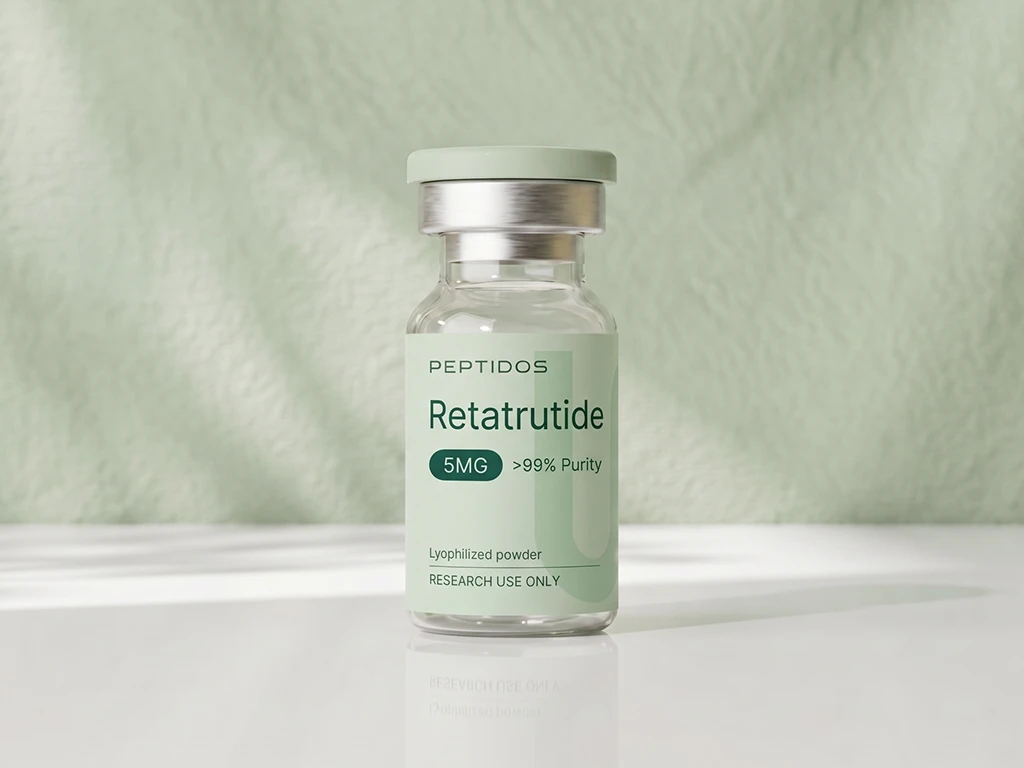
Retatrutide (LY3437943) is a synthetic peptide composed of 39 amino acids, engineered with a C20 fatty diacid moiety that extends its half-life to approximately six days and supports once-weekly administration in research settings. Originally developed by Eli Lilly, it belongs to a new generation of nutrient-stimulated hormone-based research compounds and has drawn substantial scientific attention for its unique triple-agonist activity.
Unlike single- or dual-receptor peptides, Retatrutide simultaneously targets three key metabolic receptors: the glucagon-like peptide-1 receptor (GLP-1R), the glucose-dependent insulinotropic polypeptide receptor (GIPR), and the glucagon receptor (GCGR). This combined activity makes it one of the most extensively studied triagonist peptides in preclinical and clinical metabolic research (Coskun et al., 2022).
Mechanism of Action
Retatrutide is studied for its balanced yet distinct activation of three G protein-coupled receptors that regulate energy balance, appetite, and glucose homeostasis. It demonstrates higher potency at the GIP receptor (EC50: 0.0643 nM) relative to the GLP-1 (EC50: 0.775 nM) and glucagon (EC50: 5.79 nM) receptors (Li et al., 2024).
Through GLP-1R activation, Retatrutide is associated with enhanced glucose-stimulated insulin secretion, delayed gastric emptying, and increased satiety. GIPR agonism supports glucose-dependent insulin release and lipid metabolism, while GCGR activation is linked to increased energy expenditure, hepatic lipolysis, and thermogenesis — processes that together distinguish it from earlier incretin-based research compounds such as semaglutide and tirzepatide.
Research Use Only
Retatrutide supplied by Peptidos.eu is intended exclusively for laboratory and scientific research. It is not approved for human or animal consumption and must not be used as a medicine or diagnostic tool.
- Chemical name
- Retatrutide (triple GLP-1 / GIP / glucagon receptor agonist)
- Purity
- 99.58%
- Molecular formula
- C₂₂₁H₃₄₂N₄₆O₆₈
- Amino acid sequence
- Tyr-Aib-Gln-Gly-Thr-Phe-Thr-Ser-Asp-Tyr-Ser-Ile-αMeLeu-Leu-Asp-Lys-Lys(AEEA-γGlu-C20 diacid)-Ala-Gln-Aib-Ala-Phe-Ile-Glu-Tyr-Leu-Leu-Glu-Gly-Gly-Pro-Ser-Ser-Gly-Ala-Pro-Pro-Pro-Ser-NH₂
- CAS number
- 2381089-83-2
- Molecular weight
- 4731.33 g/mol
- Number of amino acids
- 39
- Appearance
- White to off-white lyophilized powder.
- Solubility / reconstitution
- Water-soluble; reconstitute in bacteriostatic or sterile water (may require gentle swirling and pH adjustment toward neutral/slightly basic for full dissolution). Also soluble in DMSO (~50 mg/mL). Yields a clear, colorless solution.
- Storage
- Stable for ~24 months lyophilized at −20 °C, protected from light and moisture. After reconstitution, store at 2–8 °C and use within ~2–4 weeks; for longer storage, aliquot and freeze at −20 °C. Avoid repeated freeze-thaw cycles.

- Coskun, T., et al. (2022). LY3437943, a novel triple glucagon, GIP, and GLP-1 receptor agonist for glycemic control and weight loss: From discovery to clinical proof of concept. Cell Metabolism, 34(9), 1234–1247.
- Urva, S., et al. (2022). LY3437943, a novel triple GIP, GLP-1, and glucagon receptor agonist in people with type 2 diabetes: a phase 1b, multicentre, double-blind, placebo-controlled, randomised, multiple-ascending dose trial. The Lancet, 400(10366), 1869–1881.
- Jastreboff, A. M., et al. (2023). Triple–hormone-receptor agonist retatrutide for obesity — A phase 2 trial. New England Journal of Medicine, 389(6), 514–526.
- Rosenstock, J., et al. (2023). Retatrutide, a GIP, GLP-1 and glucagon receptor agonist, for people with type 2 diabetes: a randomised, double-blind, placebo and active-controlled, parallel-group, phase 2 trial conducted in the USA. The Lancet, 402(10401), 529–544.
- Sanyal, A. J., et al. (2024). Triple hormone receptor agonist retatrutide for metabolic dysfunction-associated steatotic liver disease: a randomized phase 2a trial. Nature Medicine, 30(7), 2037–2048.
- Urva, S., et al. (2023). The novel GIP, GLP-1 and glucagon receptor agonist retatrutide delays gastric emptying. Diabetes, Obesity and Metabolism, 25(9), 2784–2788.
- Coskun, T., et al. (2025). Effects of retatrutide on body composition in people with type 2 diabetes: a substudy of a phase 2, double-blind, parallel-group, placebo-controlled, randomised trial. The Lancet Diabetes & Endocrinology, 13(8), 674–684.
- Belal, M. M., et al. (2025). Efficacy and safety of retatrutide, a novel GLP-1, GIP, and glucagon receptor agonist for obesity treatment: a systematic review and meta-analysis of randomized controlled trials. Baylor University Medical Center Proceedings, 38(3).
- Conceição-Furber, E., et al. (2022). Is glucagon receptor activation the thermogenic solution for treating obesity? Frontiers in Endocrinology, 13, 868037.
- Jastreboff, A. M., et al. (2023). Triple–Hormone-Receptor Agonist Retatrutide for Obesity. Reply. New England Journal of Medicine, 389(17), 1629–1630.
Disclaimer
The products offered by peptidos.eu are intended exclusively for research and laboratory use and are sold only to qualified professionals, institutions, or authorized entities. These products are not intended for human or veterinary consumption, nor for any application involving living organisms, including — but not limited to — diagnostic, therapeutic, or recreational purposes.
By Making a Purchase, the Customer Declares that:
They are a qualified professional or entity, possessing the necessary competence, training, and facilities for the safe handling of chemical reagents;
They will use the product in full compliance with all applicable local, national, and European Union laws and regulations;
They will adopt appropriate safety measures during all stages of handling, storage, and disposal.
Prohibited Uses
The product must not be used as an Active Pharmaceutical Ingredient (API) in the manufacturing or preparation of medicines intended for humans or animals;
Any direct administration or use on humans or animals is strictly prohibited;
Peptidos.eu does not endorse or permit the use of its products for the production, testing, or development of illegal substances.
Liability
The purchaser assumes full responsibility for the handling, storage, and use of the product in safe conditions and in compliance with the law.
Peptidos.eu shall not be held liable for any direct or indirect damages arising from improper use, incorrect storage, or unauthorized use of the product.
Peptidos.eu reserves the right to refuse the sale to any individual or entity suspected of improper use of its products.
In case of doubts regarding the safe and lawful use of the product, it is recommended to consult a qualified professional experienced in laboratory research.
Regulatory Compliance
Peptidos.eu does not claim or imply that its products are approved by the European Medicines Agency (EMA), the Food and Drug Administration (FDA), or any other regulatory authority. All information provided is for informational and scientific purposes only. These products are not intended to diagnose, treat, cure, or prevent any disease.
Related products
The European Standard for Research Peptides
Born in Scandinavia. Built on the principle that research-grade means exactly that. Why researchers choose Peptidos:
- High purity
- Batch-to-batch consistency
- Most comprehensive testing available
- Professional support from people who understand