Epitalon
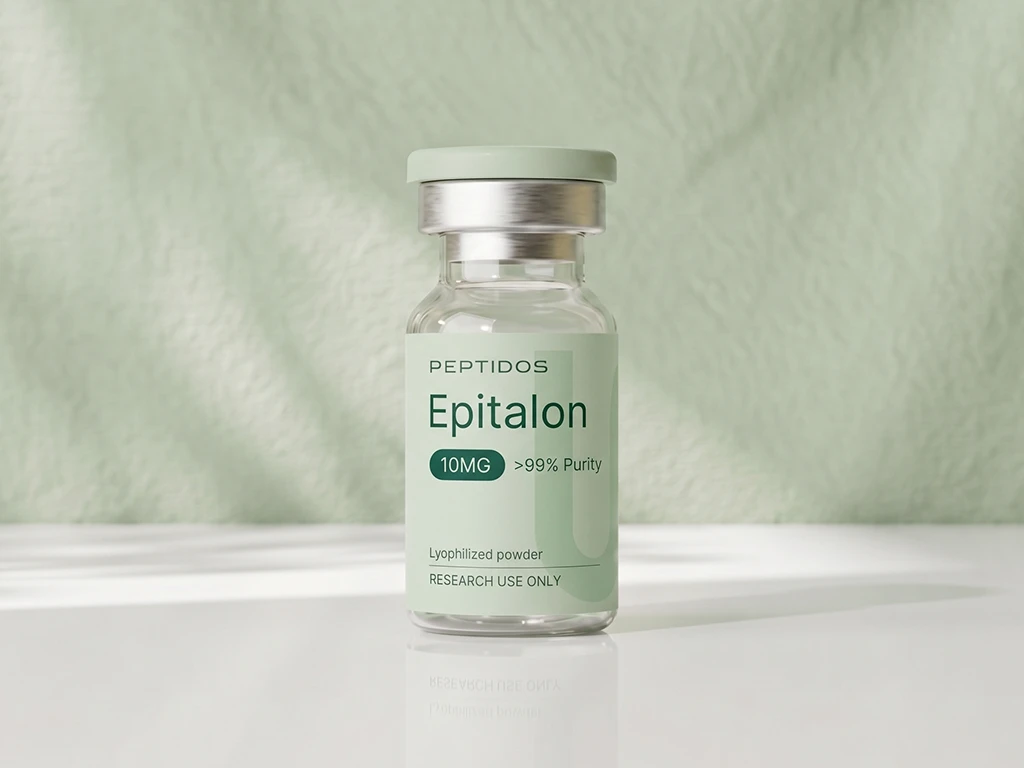
Epitalon is a synthetic tetrapeptide inspired by a natural compound produced in the pineal gland, studied for its role in cellular aging and longevity research.
What Is Epitalon?
Synthetic tetrapeptide studied for its role in telomerase activation, pineal gland regulation, and cellular longevity. Epitalon (also known as Epithalon or Epithalone) is a synthetic tetrapeptide composed of four amino acids: Alanine, Glutamic acid, Aspartic acid, and Glycine (Ala-Glu-Asp-Gly, or AEDG). It was developed by gerontologist Professor Vladimir Khavinson at the SPbIBG, based on Epithalamin, a natural polypeptide complex isolated from the pineal gland (Khavinson et al., 2017).
As a research compound, Epitalon has attracted significant scientific interest for its geroprotective and neuroendocrine properties, with over 25 years of preclinical data. Its biological role relates to regulating pineal gland function, supporting telomere maintenance, and influencing the body's natural circadian and antioxidant systems (Araj et al., 2025).
Mechanism of Action
Epitalon is studied for its ability to activate telomerase, the enzyme responsible for maintaining telomere length, through induction of the hTERT gene in human somatic cells. In landmark experiments, Epitalon-treated human fetal fibroblasts exceeded the Hayflick limit, dividing well beyond the natural replicative ceiling of untreated controls (Khavinson, Bondarev & Butyugov, 2003).
Recent work suggests Epitalon may interact directly with the hTERT gene promoter and histone H1, modulating chromatin structure through epigenetic mechanisms (Khavinson et al., 2020).
Research Use Only
Epitalon supplied by Peptidos.eu is intended exclusively for laboratory and scientific research. It is not approved for human or animal consumption and must not be used as a medicine or diagnostic tool.
- Chemical name
- Epitalon
- Purity
- 99.516%
- Molecular formula
- C₁₄H₂₂N₄O₉
- Amino acid sequence
- Ala-Glu-Asp-Gly
- CAS number
- 307297-39-8
- Molecular weight
- 390.35 g/mol
- Number of amino acids
- 4
- Appearance
- White lyophilized (freeze-dried) powder.
- Solubility / reconstitution
- Highly water-soluble. Reconstitute in bacteriostatic or sterile water; dissolves readily to a clear, colorless solution. Also soluble in DMSO (~78 mg/mL); insoluble in ethanol.
- Storage
- Stable for ~24–36 months lyophilized at −20 °C, protected from light and moisture. After reconstitution, store at 2–8 °C and use within ~1–2 weeks. Avoid repeated freeze-thaw cycles.
- Khavinson, V. Kh., Bondarev, I. E., & Butyugov, A. A. (2003). Epithalon peptide induces telomerase activity and telomere elongation in human somatic cells. Bulletin of Experimental Biology and Medicine, 135(6), 692–695.
- Khavinson, V. Kh., Izmaylov, D. M., Obukhova, L. K., & Malinin, V. V. (2000). Effect of epitalon on the lifespan increase in Drosophila melanogaster. Mechanisms of Ageing and Development, 120(1–3), 141–149.
- Anisimov, V. N., Khavinson, V. Kh., Provinciali, M., Alimova, I. N., Baturin, D. A., Popovich, I. G., Zabezhinski, M. A., Imyanitov, E. N., Mancini, R., & Franceschi, C. (2002). Inhibitory effect of the peptide epitalon on the development of spontaneous mammary tumors in HER-2/neu transgenic mice. International Journal of Cancer, 101(1), 7–10.
- Anisimov, V. N., Khavinson, V. Kh., Popovich, I. G., Zabezhinski, M. A., Alimova, I. N., Rosenfeld, S. V., Zavarzina, N. Yu., Semenchenko, A. V., & Yashin, A. I. (2003). Effect of Epitalon on biomarkers of aging, life span and spontaneous tumor incidence in female Swiss-derived SHR mice. Biogerontology, 4(4), 193–202.
- Khavinson, V. Kh., Goncharova, N., & Lapin, B. (2001). Synthetic tetrapeptide epitalon restores disturbed neuroendocrine regulation in senescent monkeys. Neuroendocrinology Letters, 22(4), 251–254.
- Korkushko, O. V., Khavinson, V. Kh., Shatilo, V. B., & Antonyk-Sheglova, I. A. (2011). Peptide geroprotector from the pituitary gland inhibits rapid aging of elderly people: results of 15-year follow-up. Bulletin of Experimental Biology and Medicine, 151(3), 366–369.
- Kozina, L. S., Arutjunyan, A. V., & Khavinson, V. Kh. (2007). Antioxidant properties of geroprotective peptides of the pineal gland. Archives of Gerontology and Geriatrics, 44(Suppl 1), 213–216.
- Sibarov, D. A., Vol'nova, A. B., Frolov, D. S., & Nozdrachev, A. D. (2007). Effects of intranasal administration of epitalon on neuron activity in the rat neocortex. Neuroscience and Behavioral Physiology, 37(9), 889–893.
- Khavinson, V. Kh., Popovich, I. G., Linkova, N. S., Mironova, E. S., & Ilina, A. R. (2020). Peptide regulation of gene expression: a systematic review. Molecules, 26(22), 7053.
- Al-Dulaimi, S., Thomas, A., Matta, S., & Roberts, T. (2025). Epitalon increases telomere length in human cell lines through telomerase upregulation or ALT activity. Biogerontology, 26(5), 175.
Disclaimer
The products offered by peptidos.eu are intended exclusively for research and laboratory use and are sold only to qualified professionals, institutions, or authorized entities. These products are not intended for human or veterinary consumption, nor for any application involving living organisms, including — but not limited to — diagnostic, therapeutic, or recreational purposes.
By Making a Purchase, the Customer Declares that:
They are a qualified professional or entity, possessing the necessary competence, training, and facilities for the safe handling of chemical reagents;
They will use the product in full compliance with all applicable local, national, and European Union laws and regulations;
They will adopt appropriate safety measures during all stages of handling, storage, and disposal.
Prohibited Uses
The product must not be used as an Active Pharmaceutical Ingredient (API) in the manufacturing or preparation of medicines intended for humans or animals;
Any direct administration or use on humans or animals is strictly prohibited;
Peptidos.eu does not endorse or permit the use of its products for the production, testing, or development of illegal substances.
Liability
The purchaser assumes full responsibility for the handling, storage, and use of the product in safe conditions and in compliance with the law.
Peptidos.eu shall not be held liable for any direct or indirect damages arising from improper use, incorrect storage, or unauthorized use of the product.
Peptidos.eu reserves the right to refuse the sale to any individual or entity suspected of improper use of its products.
In case of doubts regarding the safe and lawful use of the product, it is recommended to consult a qualified professional experienced in laboratory research.
Regulatory Compliance
Peptidos.eu does not claim or imply that its products are approved by the European Medicines Agency (EMA), the Food and Drug Administration (FDA), or any other regulatory authority. All information provided is for informational and scientific purposes only. These products are not intended to diagnose, treat, cure, or prevent any disease.
Related products
The European Standard for Research Peptides
Born in Scandinavia. Built on the principle that research-grade means exactly that. Why researchers choose Peptidos:
- High purity
- Batch-to-batch consistency
- Most comprehensive testing available
- Professional support from people who understand