Thymalin
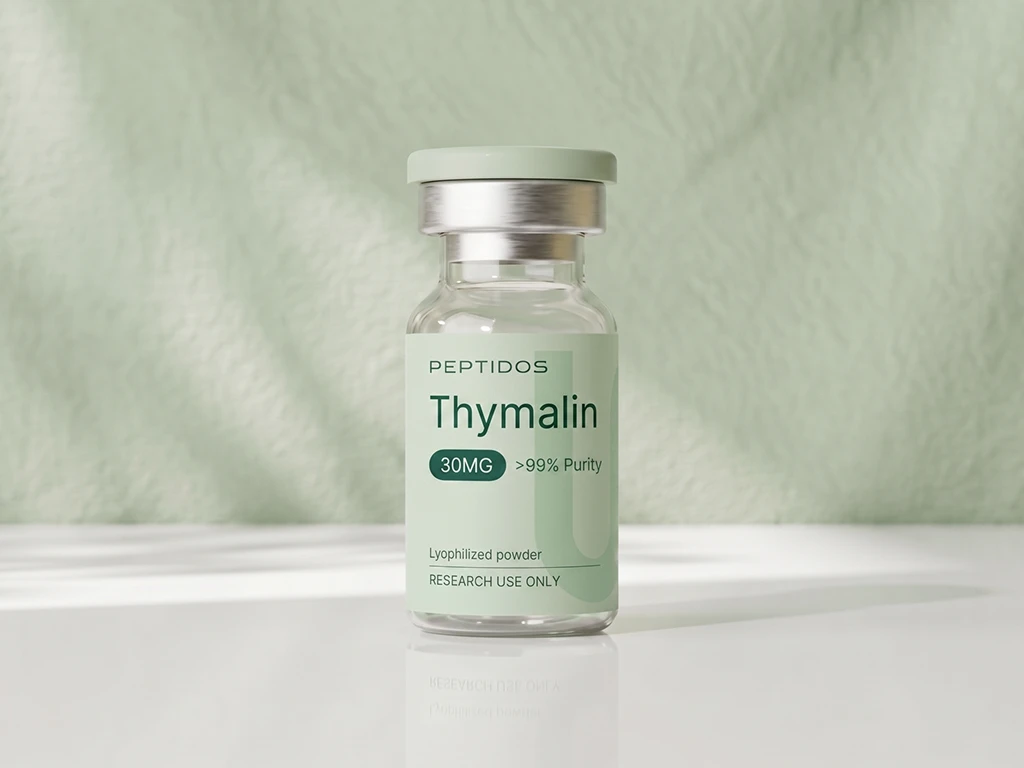
Synthetic nonapeptide identical to a naturally occurring thymic hormone, studied for its role in immune restoration, T-cell maturation, and age-related immune decline.
What Is Thymalin?
Thymalin is a synthetic peptide composed of 9 amino acids, identical in sequence to thymulin — a naturally occurring zinc-dependent thymic hormone first isolated from the thymus gland in 1977. As a research compound, it has attracted significant scientific interest for its immunomodulatory and geroprotective properties, extensively documented in preclinical and clinical research models developed primarily by Russian researchers Khavinson and Morozov.
Its underlying biological role relates to regulating T-cell differentiation and restoring immune competence, particularly in the context of age-related thymic decline. Studies indicate that Thymalin enhances T-helper and cytotoxic T-cell activity, normalizes CD4/CD8 ratios, and modulates gene expression linked to immune signaling and cellular aging (Bach et al., 1977; Khavinson et al., 2020). Its activity is dependent on coordination with zinc, which is essential for biological function.
Mechanism of Action
Thymalin is studied for its ability to bind zinc and form a biologically active complex that interacts with T-lymphocyte precursors, promoting their differentiation into mature, functional immune cells (Dardenne et al., 1982; Goldstein, 2007). It also influences natural killer (NK) cell activity, antibody production, and gene expression pathways related to immunosenescence and apoptosis.
Research Use Only
Thymalin supplied by Peptidos.eu is intended exclusively for laboratory and scientific research. It is not approved for human or animal consumption and must not be used as a medicine or diagnostic tool.
- Chemical name
- Thymalin (Thymulin, Serum Thymic Factor)
- Purity
- 99.367%
- Molecular formula
- C₃₃H₅₄N₁₂O₁₅
- Amino acid sequence
- Pyr-Ala-Lys-Ser-Gln-Gly-Gly-Ser-Asn
- CAS number
- 63958-90-7
- Molecular weight
- 858.86 g/mol
- Number of amino acids
- 9
- Appearance
- White to off-white lyophilized powder.
- Solubility / reconstitution
- Highly water-soluble. Reconstitute in bacteriostatic water; dissolves readily to a clear solution.
- Storage
- Stable for 36 months (lyophilized, 2–8°C). After reconstitution store at 4°C and use within ~2 weeks.
- Bach, J. F., et al. (1977). Isolation, biochemical characteristics, and biological activity of a circulating thymic hormone in the mouse and in the human. Annals of the New York Academy of Sciences, 249, 186–210.
- Dardenne, M., et al. (1982). Contribution of zinc and other metals to the biological activity of the serum thymic factor. Proceedings of the National Academy of Sciences, 79(17), 5370–5373.
- Morozov, V. G., & Khavinson, V. K. (1997). Natural and synthetic thymic peptides as therapeutics for immune dysfunction. International Journal of Immunopharmacology, 19(9–10), 501–505.
- Khavinson, V. K., et al. (2000). Effect of peptides on lymphocyte cell receptor expression in chronic obstructive bronchitis. Biochemistry (Moscow), 65(8), 901–908.
- Khavinson, V. K. (2002). Peptides and ageing. Neuroendocrinology Letters, 23 Suppl 3, 11–144.
- Khavinson, V. K., & Morozov, V. G. (2003). Peptides of the pineal gland and thymus prolong human life. Neuroendocrinology Letters, 24(3–4), 233–240.
- Goldstein, A. L. (2007). History of the discovery of the thymosins. Annals of the New York Academy of Sciences, 1112, 1–13.
- Anisimov, V. N., et al. (2017). Effects of peptide preparations on lifespan and tumor incidence in rats and mice. Archives of Gerontology and Geriatrics, 71, 142–146.
- Khavinson, V. K., et al. (2020). Thymalin: Activation of differentiation of human hematopoietic stem cells. Bulletin of Experimental Biology and Medicine, 170(1), 118–122.
- Khavinson, V. K., et al. (2021). Results of clinical trial of thymalin in patients with severe COVID-19. Bulletin of Experimental Biology and Medicine, 171(2), 261–266.
Disclaimer
The products offered by peptidos.eu are intended exclusively for research and laboratory use and are sold only to qualified professionals, institutions, or authorized entities. These products are not intended for human or veterinary consumption, nor for any application involving living organisms, including — but not limited to — diagnostic, therapeutic, or recreational purposes.
By Making a Purchase, the Customer Declares that:
They are a qualified professional or entity, possessing the necessary competence, training, and facilities for the safe handling of chemical reagents;
They will use the product in full compliance with all applicable local, national, and European Union laws and regulations;
They will adopt appropriate safety measures during all stages of handling, storage, and disposal.
Prohibited Uses
The product must not be used as an Active Pharmaceutical Ingredient (API) in the manufacturing or preparation of medicines intended for humans or animals;
Any direct administration or use on humans or animals is strictly prohibited;
Peptidos.eu does not endorse or permit the use of its products for the production, testing, or development of illegal substances.
Liability
The purchaser assumes full responsibility for the handling, storage, and use of the product in safe conditions and in compliance with the law.
Peptidos.eu shall not be held liable for any direct or indirect damages arising from improper use, incorrect storage, or unauthorized use of the product.
Peptidos.eu reserves the right to refuse the sale to any individual or entity suspected of improper use of its products.
In case of doubts regarding the safe and lawful use of the product, it is recommended to consult a qualified professional experienced in laboratory research.
Regulatory Compliance
Peptidos.eu does not claim or imply that its products are approved by the European Medicines Agency (EMA), the Food and Drug Administration (FDA), or any other regulatory authority. All information provided is for informational and scientific purposes only. These products are not intended to diagnose, treat, cure, or prevent any disease.
Related products
The European Standard for Research Peptides
Born in Scandinavia. Built on the principle that research-grade means exactly that. Why researchers choose Peptidos:
- High purity
- Batch-to-batch consistency
- Most comprehensive testing available
- Professional support from people who understand