SLU-PP-332: The "Exercise in a Pill" Molecule That Made Sedentary Mice Run 70% Longer
A research-based look at one of the most talked-about compounds in metabolic science — what it actually does, what it might do for humans, and why nobody has tested it on people yet in 2026.
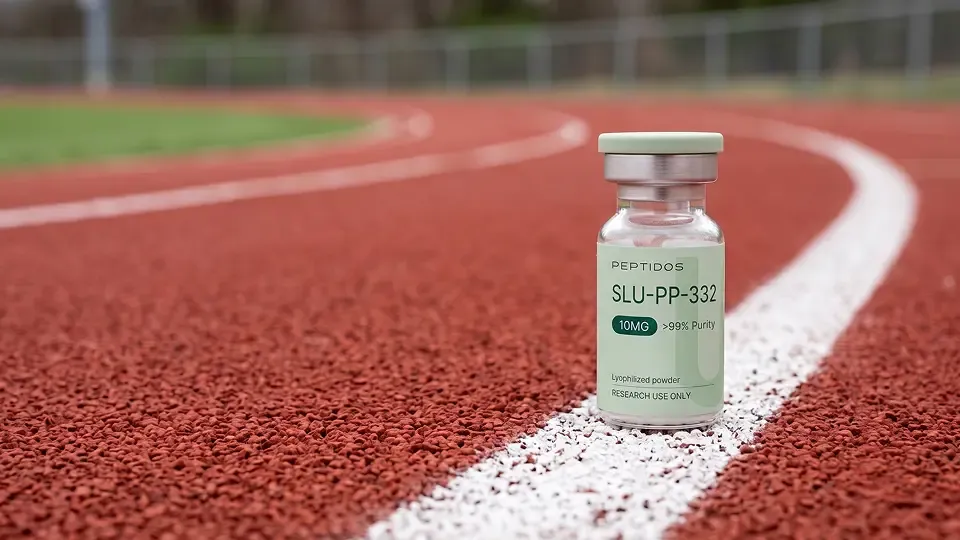
Imagine taking a compound for a week, never lacing up a single running shoe, and then crushing your previous treadmill record by 70%. That's what happened to a group of mice in 2023. They didn't train. They didn't move more. They didn't even eat differently. Their muscles just… started acting like they'd been training for a marathon.
That compound is SLU-PP-332, and it's quietly become one of the most fascinating molecules in modern metabolic research. In this article, the Peptidos Research Team breaks down what it is, what the science actually shows, and what's still completely unknown.
What Is SLU-PP-332?
First, let's clear up a common confusion: despite what half the internet calls it, SLU-PP-332 is not a peptide. It's a small synthetic molecule — closer in structure to a drug than to BPC-157 or any of the GLP-1 weight-loss compounds. The "SLU" stands for Saint Louis University, where the lab of Thomas Burris first developed it before moving the work to the University of Florida.
What it does is unusual. SLU-PP-332 turns on a family of cellular receptors called estrogen-related receptors (ERRα, ERRβ, and ERRγ). Don't let the "estrogen" part throw you — these receptors don't actually bind estrogen, and the compound has nothing to do with sex hormones. The name is a historical accident. They're actually called "orphan receptors" because for years scientists couldn't figure out what natural molecule was supposed to switch them on.
Here's why they matter: ERRs are master regulators of mitochondrial activity. When you exercise — really exercise, the kind that leaves you breathing hard — your muscles activate ERRs as part of the cellular response. They turn on genes that build new mitochondria, increase fat burning, and shift muscle fibers toward the slow-twitch endurance type.
SLU-PP-332 essentially walks into that control room and flips all those switches itself. No workout required.
The Mouse Data Is Genuinely Surprising
Most "exercise mimetics" you read about in the news don't survive a closer look. SLU-PP-332 actually does — at least in rodents.
The headline result came from a 2023 paper in the Journal of Pharmacology and Experimental Therapeutics. After just seven days of treatment, normal-weight mice ran 70% longer and 45% further than mice that didn't get the drug. Burris, the lead researcher, summed it up by saying the treated mice looked like they had been doing endurance training. They hadn't done any.
That alone would be interesting. But the follow-up findings are arguably more important.
- In diet-induced obese mice, SLU-PP-332 caused fat mass to drop roughly 25–30% over four weeks — without changing how much the mice ate or how much they moved. Cholesterol fell. Triglycerides fell. Glucose tolerance improved. The compound essentially flipped the body into a fasted, fat-burning state while the animals were still munching on their high-fat diet.
- In aging mice with declining kidney function, eight weeks of treatment reversed several markers of aging in the kidneys, including mitochondrial damage and inflammatory signaling. The effects were comparable to lifelong caloric restriction — a benchmark that's notoriously hard to match pharmacologically.
- In a mouse heart failure model, published in Circulation in 2024, SLU-PP-332 improved heart pumping function, restored mitochondrial structure, and reduced fibrosis. The benefit appeared to come mostly from activating ERRγ in cardiac muscle, which switched the failing heart's metabolism back toward fat oxidation — the fuel a healthy heart prefers.
There's also a quirky but striking detail from the original endurance work. Endurance training in humans gradually converts fast-twitch muscle fibers into the more fatigue-resistant Type IIa variety over months of consistent work. SLU-PP-332 seemed to accelerate this transformation in mice within roughly two weeks.
Why It's Not GLP-1 (And Why That Matters)
Drugs like semaglutide and tirzepatide work mostly by suppressing appetite. People eat less, lose weight, and the muscle loss that comes with rapid fat loss has become a real concern.
SLU-PP-332 works through a completely different mechanism. It doesn't touch appetite. It doesn't fiddle with hunger hormones. It increases the demand side of the energy equation — making cells burn more fat at rest — rather than reducing the supply side. In theory, that's a much more attractive metabolic profile, especially for older adults who already struggle to maintain muscle mass.
The Big Asterisk: No Human Trials Exist
Here's the part the supplement industry tends to bury at the bottom of the page. As of 2026, there are zero registered human trials of SLU-PP-332.
The dose used in mice is also much higher than what people would potentially take. Research mice typically received 25–50 mg/kg by injection. Translating that to humans isn't a simple multiplication, and pharmacokinetics in humans haven't been measured at all. The published mouse data shows the compound clears the bloodstream relatively quickly and reaches reasonable concentrations in skeletal muscle.
Regulatory Status
In the United States, SLU-PP-332 sits in a regulatory gray zone — not scheduled, not approved as a drug, not recognized as a supplement. In most of Europe, it can be legally purchased for research purposes but cannot be sold as a medicine or supplement.
The World Anti-Doping Agency has not yet placed SLU-PP-332 on its banned list as of 2026, but compounds in the broader category of "metabolic modulators" are explicitly prohibited in sport, and several anti-doping researchers have flagged ERR agonists as likely future additions.
Is SLU-PP-332 Actually Promising?
Here's the honest answer: SLU-PP-332 is one of the most genuinely exciting compounds in early metabolic research. The rodent data is consistent across multiple labs, multiple disease models, and multiple research teams. The mechanism makes biological sense. And the potential applications — obesity, heart failure, aging, kidney decline, sarcopenia — are exactly the conditions modern medicine struggles most to treat.
The history of exercise mimetics is had cases with compounds that looked spectacular in rodents and did not show the same effect when tested in people. SLU-PP-332 deserves serious attention from researchers.
Key Takeaway on SLU-PP-332
SLU-PP-332 is a small synthetic molecule that activates the same cellular machinery your body turns on during endurance exercise — but without you having to actually exercise. In animal studies, it's increased running distance dramatically, reduced fat mass without affecting appetite, improved heart function in failing hearts, and reversed aging-related changes in kidneys.
References
- Billon, C. et al. (2023). "Synthetic ERRα/β/γ Agonist Induces an ERRα-Dependent Acute Aerobic Exercise Response and Enhances Exercise Capacity." Journal of Pharmacology and Experimental Therapeutics, PMC11584170.
- Billon, C. et al. (2024). "A Synthetic ERR Agonist Alleviates Metabolic Syndrome." Journal of Pharmacology and Experimental Therapeutics, PMC10801787.
- Xu, W. et al. (2024). "Novel Pan-ERR Agonists Ameliorate Heart Failure Through Enhancing Cardiac Fatty Acid Metabolism and Mitochondrial Function." Circulation, 149(22), 1875–1891.
- Wang, X.X. et al. (2023). "Estrogen-Related Receptor Agonism Reverses Mitochondrial Dysfunction and Inflammation in the Aging Kidney." American Journal of Pathology, 193(12), 1969–1987.
- Burris, T.P. et al. (2023). "Exercise-mimicking drug sheds weight, boosts muscle activity in mice." University of Florida News, September 2023.
- Losby, M. et al. (2024). "The Estrogen Receptor-Related Orphan Receptors (ERRs) Regulate Autophagy through TFEB." Molecular Metabolism.
- Nasri, H. (2024). "New hopes on 'SLU-PP-332' as an effective agent for weight loss with indirect kidney protection efficacy: a nephrology point of view." Journal of Renal Endocrinology, 10, e25143.
- Hagiu, B-A. (2024). "Can SLU-PP-332 be a new drug to prevent COVID-19?" Medical Hypotheses, 187, 111362.
- Chatterjee, A. et al. (2025). "Chemical optimization of the exercise mimetic SLU-PP-332 enables insight into estrogen-related receptor signaling." European Journal of Medicinal Chemistry, PMC13112601.
- ClinicalTrials.gov (2026). "Search results for 'SLU-PP-332': No registered studies." Accessed April 2026.
- Wansapura, A.N. et al. (2024). "Pharmacological Activation of ERR via SLU-PP-332 Reduces Adiposity and Improves Metabolic Parameters in Obese Mouse Models." Cited in PMID 37739806.
- Cayman Chemical (2024). "SLU-PP-332 Product Insert and Pharmacology Summary." Cayman Chemical Item No. 41719.
Author

Peptidos
Research Team
We are a Scandinavian longevity research team with 15+ years of combined experience studying peptides' role in aging, cellular health, muscle growth, and cognitive performance.
Sign up to our newsletter