Selank: The Anti-Anxiety Peptide Without Sedation — Research Summary 2026
A research-based look at one of the most studied neuropeptides in modern neuropharmacology, including how it appears to calm anxiety without sedation, what the science says about its cognitive effects, and where the evidence still falls short in 2026.
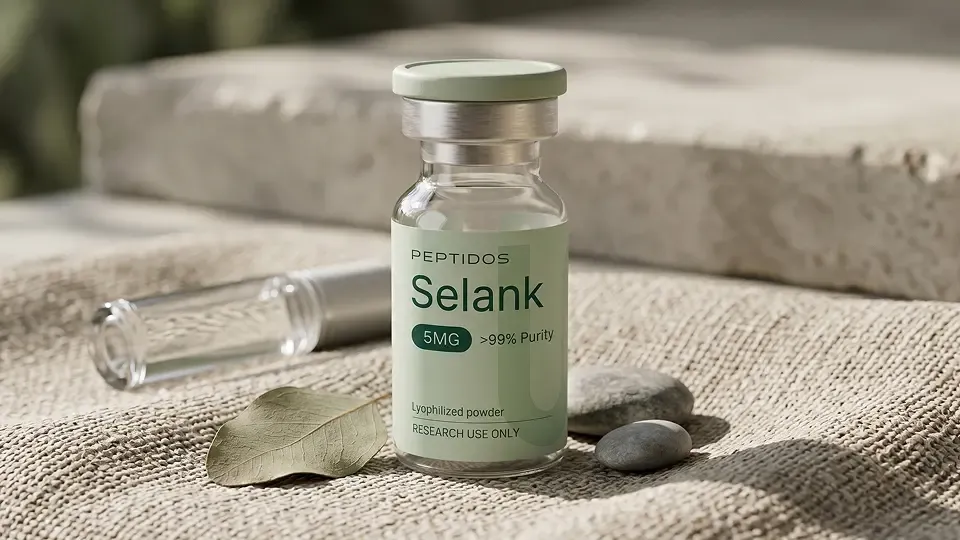
While most peptides in the wellness and longevity space focus on tissue repair or metabolism, Selank stands out for something different: it targets the brain. Originally developed in Russia and approved there for generalized anxiety disorder, this small synthetic peptide has accumulated more than three decades of preclinical research and a modest but growing body of human data. In this article, the Peptidos Research Team breaks down what the science actually tells us about Selank — and where the gaps remain.
What Is Selank?
Selank is a synthetic heptapeptide, meaning a chain of seven amino acids. It was developed in the early 1990s at the Institute of Molecular Genetics of the Russian Academy of Sciences, in collaboration with the V.V. Zakusov Research Institute of Pharmacology.
Structurally, Selank is a stabilized analog of tuftsin — a naturally occurring tetrapeptide found in the heavy chain of human immunoglobulin G that plays a role in immune signaling. Researchers added the tripeptide to tuftsin's C-terminus to make the molecule resistant to enzymatic breakdown. This modification dramatically extended its biological half-life and made it suitable for therapeutic use.
The result is a peptide with a dual identity: it retains some of tuftsin's immunomodulatory profile while showing pronounced effects on the central nervous system. That combination — calming the mind while modulating immune signaling — is part of what has kept researchers interested for so long.
What Has the Selank Research Found?
The body of preclinical work on Selank is substantial, with studies spanning neurotransmitter systems, behavioral models, and cellular gene expression. Several mechanisms have emerged consistently across the literature.
Anxiety Reduction Without Sedation
This is the area where Selank has the strongest signal. In animal models, Selank produces anxiolytic effects comparable to classical benzodiazepines like diazepam and medazepam — but without the sedation, motor impairment, or dependence that come with those drugs.
The mechanism appears to involve allosteric modulation of the GABAergic system. Unlike benzodiazepines, which directly bind to and activate GABA-A receptors, Selank seems to influence the system more indirectly. Studies have shown it changes the expression of genes encoding GABA receptor subunits, transporters, and ion channels in rat brain tissue, and that it modifies the number of GABA-binding sites without altering receptor affinity.
In plain language: Selank appears to "tune" the brain's main inhibitory system rather than flooding it. That distinction may explain why it produces calm without the cognitive fog or dependence risk associated with benzodiazepines.
Cognitive and Nootropic Effects
Selank is unusual among anxiolytics because it appears to enhance — rather than impair — cognitive function. In rodent learning paradigms, including the Morris water maze and object recognition tests, Selank-treated animals consistently show improved memory and attention.
The most studied molecular driver here is BDNF (brain-derived neurotrophic factor), a protein essential for neuroplasticity, learning, and memory. A 2019 study published in the Bulletin of Experimental Biology and Medicine showed that intranasal Selank regulated BDNF content in the hippocampus and prefrontal cortex of rats, and protected against ethanol-induced memory impairment.
Researchers debate how much of Selank's "nootropic" reputation reflects genuine cognitive enhancement versus the secondary effect of removing anxiety as a barrier to thinking clearly. The likely answer is both — and clinical observations suggest its psychostimulant-like properties are real, even if subtle.
Mood and Neurotransmitter Modulation
Beyond GABA, Selank influences several monoamine systems. Animal studies have documented effects on serotonin, dopamine, and norepinephrine signaling, which together regulate mood, motivation, and stress response.
Selank has also been shown to inhibit enzymes that degrade enkephalins — natural opioid-like peptides involved in pain regulation and emotional resilience. By preserving endogenous enkephalin activity, it may indirectly support both mood stability and stress tolerance.
Immune Modulation and Antiviral Activity
Given its origin from tuftsin, it's no surprise that Selank shows immunomodulatory effects. Preclinical research has documented changes in cytokine expression, particularly reductions in pro-inflammatory markers like IL-6 and TNF-alpha under stress conditions, alongside enhanced phagocytic activity.
Some Russian research has also explored antiviral applications, including effects on influenza replication. While these findings are intriguing, they remain preliminary and have not yet been replicated in larger international studies.
Neuroprotective Potential
Animal models suggest Selank may help protect the brain under various stressors. Studies have explored its effects in models of chronic alcohol exposure, ischemia, and oxidative stress. The neuroprotective signal appears to combine BDNF upregulation, anti-inflammatory effects, and stabilization of key neurotransmitter systems.
The Human Evidence: Limited but Real
Compared with most research peptides, Selank actually has direct human clinical data — though the trial base remains small by modern standards.
The most-cited human study is a 2008 trial comparing Selank to medazepam (a benzodiazepine) in 62 patients with generalized anxiety disorder and neurasthenia. Selank produced anxiolytic effects similar to medazepam, but with additional antiasthenic and psychostimulant properties not seen with the benzodiazepine. Patients also showed changes in serum enkephalin activity, supporting the proposed mechanism.
A 2020 study published in Doklady Biological Sciences used resting-state fMRI in 52 healthy participants to examine how Selank and Semax affect brain connectivity. The researchers documented measurable changes in functional connectivity between the right amygdala — a key region for anxiety regulation — and parts of the right temporal cortex, providing the first neuroimaging-based evidence of Selank's effects on the human brain.
Other clinical observations from Russian psychiatric practice describe Selank's use as both a monotherapy and an adjunct treatment for anxiety disorders, with reports of rapid onset and good tolerability across hundreds of patients. However, these are largely uncontrolled clinical reports rather than blinded, placebo-controlled trials by modern Western standards.
Safety and Side Effect Profile
Selank's safety record in published research is favorable. Reported side effects are typically mild and may include headaches, mild nasal irritation (when used as a spray), occasional sinus discomfort, or transient irritability at higher doses.
Critically, no studies have documented physical dependence, tolerance with significant clinical impact, or withdrawal symptoms — a striking contrast to benzodiazepines, which carry well-known dependence and discontinuation risks. That said, long-term safety data outside of Russian clinical use remain limited, and the immunogenic potential of any synthetic peptide warrants ongoing study.
The most common research and clinical administration route is intranasal spray. The nasal route allows partial bypass of the blood-brain barrier through olfactory and trigeminal pathways, which is particularly relevant for a peptide targeting the central nervous system. Subcutaneous injection is also used in some research protocols.
Regulatory Status
Selank has been approved as a prescription anxiolytic in Russia since around 2009, sold under its trade name for the treatment of generalized anxiety disorder and related conditions. It is also approved in some neighboring Commonwealth of Independent States countries.
Outside of that regulatory zone, the picture is different. Neither the FDA nor the EMA has approved Selank for any medical use, simply because the large, modern, multi-center trials required for Western approval have not been conducted. In most of Europe, Selank can be legally purchased and possessed for laboratory research purposes, but it cannot be sold as a medicine or supplement. Australia treats it as a prescription-only substance.
Key Takeaway on Selank So Far
Selank occupies an unusual niche in peptide research: it has more direct human clinical data than most peptides discussed in longevity and biohacking circles, yet far less than what Western regulators require for approval. The mechanisms are well-described — allosteric GABA modulation, BDNF upregulation, monoamine modulation, and immune signaling — and the safety profile, based on existing data, looks favorable, particularly compared to benzodiazepines.
The most compelling aspect of Selank is the combination of effects it produces: anxiety relief without sedation, cognitive support rather than impairment, and no documented dependence. If those findings replicate in larger international trials, Selank could represent a meaningful alternative to the benzodiazepine class — one of the most prescribed and most problematic drug families in modern psychiatry. For now, the science is genuinely promising, the clinical signal is real, and the case for further research is strong.
References
- Zozulya AA, Neznamov GG, Siuniakov TS, et al. (2008). Efficacy and possible mechanisms of action of a new peptide anxiolytic selank in the therapy of generalized anxiety disorders and neurasthenia. Zh Nevrol Psikhiatr Im S S Korsakova, 108(4):38–48.
- Volkova A, Shadrina M, Kolomin T, et al. (2016). Selank Administration Affects the Expression of Some Genes Involved in GABAergic Neurotransmission. Frontiers in Pharmacology, 7:31.
- Kolomin T, Shadrina M, Slominsky P, et al. (2017). GABA, Selank, and Olanzapine Affect the Expression of Genes Involved in GABAergic Neurotransmission in IMR-32 Cells. Frontiers in Pharmacology, 8:89.
- Panikratova YR, Lebedeva IS, Sokolov OY, et al. (2020). Functional Connectomic Approach to Studying Selank and Semax Effects. Doklady Biological Sciences, 490(1):9–11.
- Kolik LG, Nadorova AV, Antipova TA, et al. (2019). Selank, Peptide Analogue of Tuftsin, Protects Against Ethanol-Induced Memory Impairment by Regulating BDNF Content in the Hippocampus and Prefrontal Cortex in Rats. Bulletin of Experimental Biology and Medicine, 167(5):641–644.
- Vyunova TV, Andreeva L, Shevchenko K, Myasoedov N. (2018). Peptide-based anxiolytics: the molecular aspects of heptapeptide Selank biological activity. Protein and Peptide Letters, 25(10):914–923.
- Ashmarin IP, Lyapina LA, Pasorova VG. (2005). Family of regulatory peptides Selank as related to tuftsin. Russian Academy of Sciences publications.
- Inozemtseva LS, Karpenko EA, Dolotov OV, et al. (2008). Intranasal administration of the peptide Selank regulates BDNF expression in the rat hippocampus in vivo. Doklady Biological Sciences, 421:241–243.
Author

Peptidos
Research Team
We are a Scandinavian longevity research team with 15+ years of combined experience studying peptides' role in aging, cellular health, muscle growth, and cognitive performance.
Sign up to our newsletter
Related articles
Semax: The "Brain Protection Peptide" - Research Summary 2026
Semax vs Selank for Cognition and Anxiety: What the Research Actually Says