Epitalon: The "Longevity Peptide" — Research Summary
A research-based look at the peptide that may slow cellular aging from the inside out, including what science has found, what it hasn't, and why the longevity community is paying close attention in 2026.
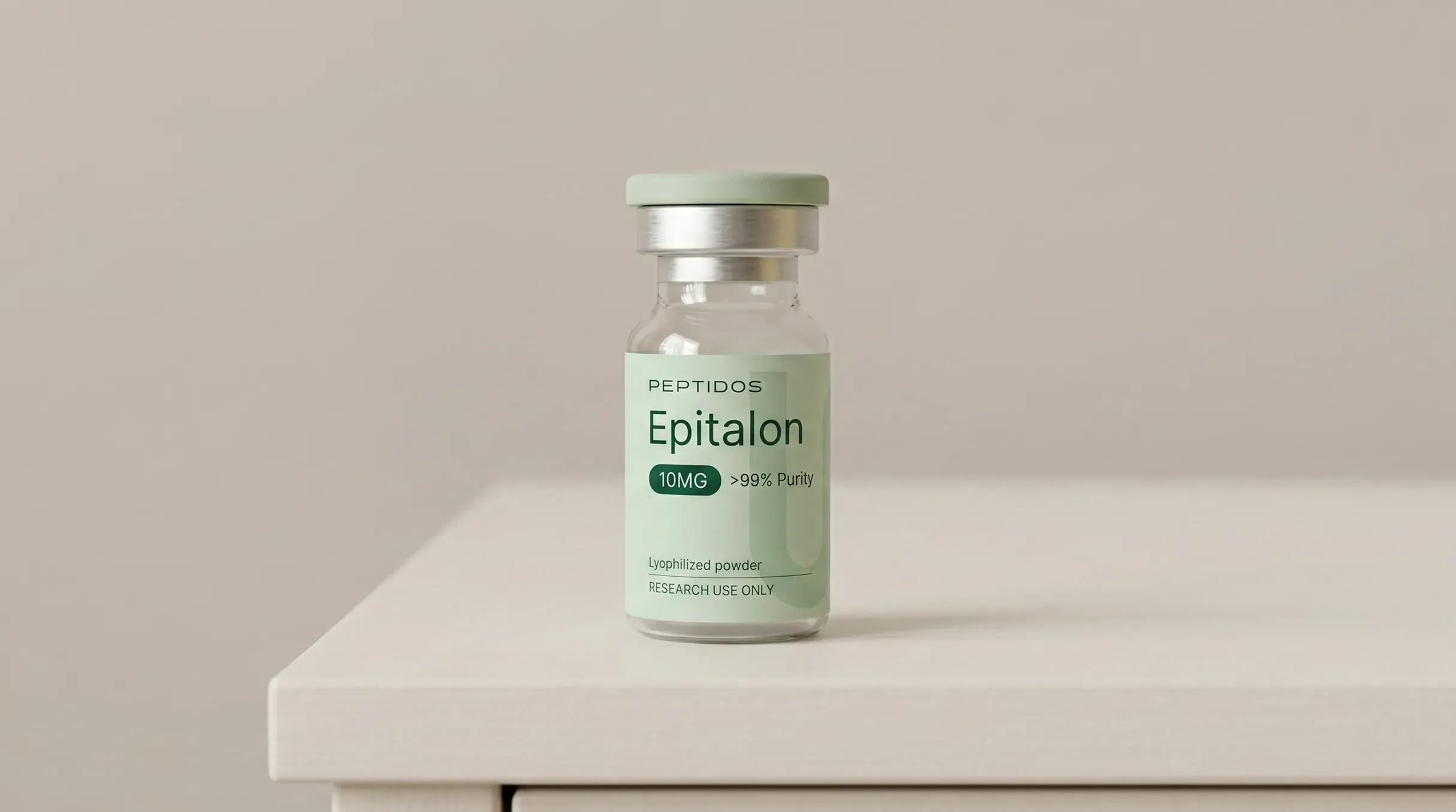
Few peptides promise something as ambitious as Epitalon. It doesn't target a single injury or calm a specific inflammatory response - it targets the molecular clock that tells your cells how old they are. Originally developed from a natural extract of the pineal gland, this tiny four-amino-acid peptide has generated over 25 years of research into whether we can actually slow biological aging at the cellular level. In this article, Peptidos Research Team breaks down what the science tells us, where the real evidence stands, and what remains unanswered.
What Is Epitalon?
Epitalon (also spelled Epithalon) is a synthetic tetrapeptide - one of the smallest biologically active peptides studied in modern science. Its amino acid sequence is just four residues long: Ala-Glu-Asp-Gly (AEDG). It was developed as a purified, synthetic version of Epithalamin, a complex peptide mixture extracted from the pineal glands of cattle.
The story begins in the 1970s at the St. Petersburg Institute of Bioregulation and Gerontology in Russia, where Professor Vladimir Khavinson and his team began investigating how peptide extracts from various organs might influence aging. They found that the crude pineal extract — Epithalamin — appeared to restore melatonin secretion, improve immune markers, and extend lifespan in animal models. The next question was obvious: which molecule in this extract was doing the work?
Through amino acid analysis, Khavinson's group identified the four-amino-acid sequence AEDG as the probable active component. They synthesised it and named it Epitalon. Remarkably, the synthetic version appeared to reproduce many of Epithalamin's effects at concentrations 1,000 to 5,000 times lower than the crude extract.
What makes Epitalon unique among peptides is its proposed target: it doesn't act on growth factors or inflammatory pathways like most regenerative peptides. Instead, it appears to interact with the machinery that protects your chromosomes — specifically, the enzyme telomerase and the protective caps called telomeres that sit at the ends of your DNA.
Telomeres and Why They Matter
To understand why Epitalon has generated such excitement, you need to understand telomeres.
Every time a cell divides, the telomeres - repetitive DNA sequences (TTAGGG) that cap the ends of your chromosomes - get slightly shorter. Think of them as the plastic tips on shoelaces: they protect the important structure underneath. When telomeres shorten past a critical threshold, the cell either stops dividing (a state called senescence) or dies. This progressive shortening is considered one of the fundamental mechanisms of biological aging.
The enzyme telomerase can rebuild telomeres, but in most adult human cells, telomerase is essentially switched off. This is actually a safety feature - unlimited cell division is a hallmark of cancer. But it also means that as we age, our telomeres steadily erode, and our cells lose their regenerative capacity.
Epitalon's central claim is that it can reactivate telomerase in normal aging cells, potentially slowing or partially reversing this aspect of cellular aging. If true, the implications would be profound.
What Has the Research Found?
The research on Epitalon spans more than 25 years across cell culture, animal models, and a small number of human studies. Here's what the key areas of investigation have shown.
Telomerase Activation and Telomere Lengthening
This is the finding that put Epitalon on the map. In a landmark 2003 study, Khavinson and colleagues showed that Epitalon activated telomerase and extended telomere length in human fetal fibroblasts — cells that are normally telomerase-negative. The treated cells continued dividing well beyond the 44th passage, while untreated controls stopped at the 34th passage (a boundary known as the Hayflick limit). Telomere lengths returned to levels comparable to the original young culture.
In 2025, a team at Brunel University London published the first independent investigation of these mechanisms outside of Khavinson's group. They confirmed that Epitalon increased telomere lengths across all cell types tested - normal and cancerous. In normal cells, the peptide upregulated hTERT (the catalytic subunit of telomerase) as expected. But in cancer cells, it appeared to work through a different mechanism — the Alternative Lengthening of Telomeres (ALT) pathway - suggesting the peptide may not simply "turn on" telomerase indiscriminately, which would raise obvious cancer concerns.
Circadian Rhythm and Melatonin Restoration
Given Epitalon's origins in the pineal gland - the brain's melatonin-producing organ - it's fitting that some of the most consistent findings involve circadian rhythm regulation.
In aged monkeys, Epitalon restored evening melatonin secretion and normalised cortisol rhythms. In a placebo-controlled study of 75 women, sublingual Epitalon increased a melatonin metabolite by 1.6 times and modulated expression of core circadian genes. In elderly human subjects, Epithalamin (the parent compound) restored nighttime melatonin peaks in those with low baseline pineal activity, while slightly reducing it in those with already-normal function - a bidirectional regulation suggesting the peptide restores natural circadian signalling rather than simply boosting melatonin in one direction.
This matters because age-related melatonin decline affects far more than sleep - it's connected to immune function, antioxidant defence, and metabolic regulation. Unlike taking exogenous melatonin (which can suppress endogenous production), Epitalon theoretically supports the pineal gland's own function.
Lifespan Extension in Animals
In the most rigorous study - 108 female SHR mice treated from age 3 months until natural death - Epitalon did not increase mean lifespan, but it extended the lifespan of the longest-surviving 10% by 13.3% and increased maximum lifespan by 12.3%. It also reduced chromosomal aberrations by 17.1% and slowed reproductive aging. In CBA mice, it decreased spontaneous tumour incidence. In Drosophila fruit flies, it increased mean lifespan by 11-16%.
Retinal Protection and Eye Health
The pineal gland and the retina share a common embryonic origin, which may explain one of Epitalon's most unexpected applications. In Campbell rats with hereditary retinitis pigmentosa, untreated animals showed complete retinal destruction by day 41. In treated animals, all retinal layers were preserved, with functional retinal activity extended by 43.9%.
This led to the largest published human trial: 162 patients with retinitis pigmentosa received parabulbar Epitalon injections daily for 10 days. Visual acuity improved in 90% of cases, peripheral visual fields expanded in all patients, and some blind spots reduced or disappeared. No side effects were reported. However, this study appears to have been uncontrolled, which limits the strength of the conclusions.
Anti-Cancer Properties
Perhaps the most important question about any telomerase-activating compound is: does it promote cancer? Across multiple animal studies, Epitalon reduced rather than increased tumour incidence - including spontaneous tumours in CBA mice, mammary tumours in HER-2/neu transgenic mice, and chemically-induced colon cancer in rats.
The 2025 Brunel study offered a possible explanation: in cancer cells, Epitalon appeared to work through ALT rather than telomerase, and may suppress telomerase in those cells via histone H1 binding. If confirmed, this would suggest a context-dependent mechanism - supporting telomere maintenance in normal cells while potentially restraining it in cancerous ones. This remains a hypothesis, but the consistent animal data is encouraging.
Antioxidant and Neuroprotective Effects
In aging rats, Epitalon boosted key antioxidant enzymes including superoxide dismutase and glutathione peroxidase. In cell studies, it reduced DNA damage markers, promoted dendrite growth, and increased brain-derived neurotrophic factor (BDNF) expression. These effects appear connected to Epitalon's broader role in supporting pineal function and the neuroendocrine balance that deteriorates with age.
The Human Evidence: Promising but Early
Compared to some other well-known research peptides, the human evidence for Epitalon is thinner and more concentrated in a single research tradition. Here's what has been published:
- Retinitis pigmentosa (2002): 162 patients received parabulbar Epitalon injections. Visual acuity improved in 90% of cases. No side effects were reported. This study was uncontrolled.
- Telomere elongation in elderly patients (2004): In patients aged 60–80, both Epitalon and Epithalamin significantly increased telomere lengths in blood cells. Average telomere elongation was reported at 33.3%.
- Melatonin restoration in elderly subjects (2004): Epithalamin restored nighttime melatonin concentrations in healthy elderly adults with low baseline pineal activity.
- Circadian rhythm regulation (2019): A placebo-controlled study in 75 women showed Epitalon enhanced melatonin metabolite excretion by 1.6-fold and modulated circadian gene expression.
- Pulmonary tuberculosis (chromosomal protection): Epitalon did not correct pre-existing chromosomal aberrations in TB patients but appeared to exert a protective effect against future chromosomal damage.
- Longevity observations with Epithalamin: A placebo-controlled trial followed 70 older adults for 12 years. Those who received Epithalamin every six months for three years showed 28% decreased mortality compared to controls.
While these results are intriguing, most come from Khavinson's institute or closely affiliated groups. The studies typically have small sample sizes and lack the randomised, double-blind, placebo-controlled designs that Western regulatory bodies require. The 2025 Brunel study represents an important step toward independent verification, but it was a cell culture study, not a clinical trial.
The Elephant in the Room: Research Concentration
This is the single biggest caveat with Epitalon research, and it deserves direct acknowledgment.
Until the 2025 Brunel University publication, virtually all published Epitalon research came from Khavinson's institute in St. Petersburg or closely affiliated groups. This isn't unusual for peptide bioregulation research in Russia — Khavinson's programme is extensive and well-funded — but it means the body of evidence lacks the independent replication that the broader scientific community expects before drawing firm conclusions.
This doesn't mean the research is wrong. It means we can't yet be as confident in the findings as we would be if multiple independent laboratories around the world had confirmed them. The 2025 Brunel study is a significant step in the right direction, and the fact that it confirmed Epitalon's telomere-lengthening effects across multiple cell types adds genuine weight to the evidence base.
Regulatory Status
Neither the EMA nor the FDA has approved Epitalon as a medicine - simply because the large-scale clinical trials required for approval have never been conducted outside of Russia.
Across most of the European Union, Epitalon is not a controlled substance. It falls outside the scope of existing medicines legislation, meaning it can legally be purchased and possessed for research purposes in many EU member states. However, it cannot be marketed or sold as a supplement, food, or medicine in Europe.
In Russia, the picture is different. Both Epitalon and its parent compound Epithalamin have been used in clinical and geriatric settings for over 30 years and are approved for clinical use - a reflection of the country's long-standing peptide bioregulation research tradition.
In the United States, the FDA classified Epitalon as a Category 2 bulk drug substance in 2023, which prevents licensed compounding pharmacies from preparing it for human use.
Interestingly, Epitalon is not currently listed as a banned substance by WADA, unlike several other popular research peptides which are explicitly prohibited.
How Does Epitalon Differ from Other Research Peptides?
Epitalon occupies a fundamentally different niche than the regenerative peptides that dominate the research peptide space.
Most popular research peptides - such as BPC-157 and TB-500 - are primarily tissue repair compounds. They accelerate healing of tendons, muscles, gut lining, and other damaged tissues through growth factor signalling and cell migration. They act relatively quickly and their effects are most apparent at injury sites.
Epitalon is a cellular aging peptide - it targets the molecular mechanisms that govern how cells age and divide. Its effects are about maintaining the regenerative capacity of cells over time. The timeline is different too: where tissue repair peptides show effects within days to weeks, Epitalon's proposed benefits relate to processes that unfold over months and years.
Epitalon also has a unique strength in animal lifespan and telomere data, though its human evidence remains more limited and more concentrated in a single research group than some of its better-known counterparts.
Key Takeaway on Epitalon
Epitalon is one of the most compelling peptides in longevity research. Over 25 years of data consistently point to telomerase activation, circadian rhythm restoration, antioxidant defence, and immune modulation - touching at least five of the twelve recognised hallmarks of aging simultaneously. The central claim of telomerase activation was independently confirmed by a 2025 study at Brunel University London, adding real weight to the evidence base.
That said, large-scale clinical trials are still missing, the research remains heavily concentrated in a single laboratory, and long-term safety questions are unresolved. Epitalon is a research peptide with strong potential, not a validated therapy but if independent research momentum continues, it could prove to be one of the most important compounds in the longevity field.
References
- Khavinson, V.Kh., Bondarev, I.E. & Butyugov, A.A. (2003). "Epithalon Peptide Induces Telomerase Activity and Telomere Elongation in Human Somatic Cells." Bulletin of Experimental Biology and Medicine, 135(6), 692–695.
- Al-Dulaimi, S., Thomas, R., Matta, S. & Roberts, T. (2025). "Epitalon increases telomere length in human cell lines through telomerase upregulation or ALT activity." Biogerontology, 26(5), 178.
- Anisimov, V.N., Khavinson, V.Kh., Popovich, I.G. et al. (2003). "Effect of Epitalon on biomarkers of aging, life span and spontaneous tumor incidence in female Swiss-derived SHR mice." Biogerontology, 4(4), 193–202.
Author

Peptidos
Research Team
We are a Nordic longevity research team with 15+ years of combined experience studying peptides' role in aging, cellular health, muscle growth, and cognitive performance.
Sign up to our newsletter

Semax: The "Brain Protection Peptide" - Research Summary 2026
GHK-Cu Peptide Research: Benefits, Effects, and Risks Explained